
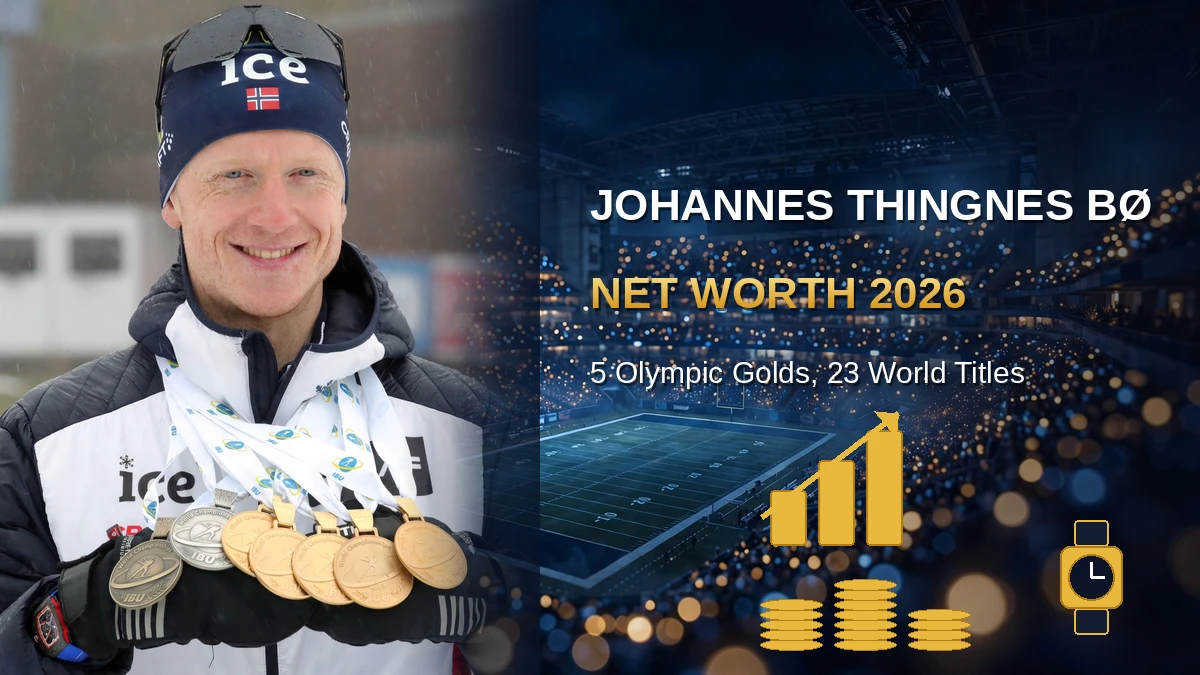

Johannes Thingnes Bø Net Worth 2026 is unconfirmed — and that is the first thing to say plainly, because almost everything else about him can be counted with unusual precision. On 23 March 2025, in front of a home crowd at Holmenkollen, one of the greatest male biathletes of his generation raced for the last time, finishing seventh in the mass start at 31, four individual wins short of Ole Einar Bjørndalen’s record of 95. He had decided two months earlier that family mattered more than another Olympics. What he left behind will take some beating: five Olympic golds, twenty-three world titles, five overall World Cup titles — and a record €477,000 prize-money season.
The question here is different: what is all of that worth, in money? No Norwegian newspaper has printed a net worth figure for Bø, he does not appear on Kapital’s list of Norway’s 400 richest, and the one number online — about $10 million from an aggregator — comes with no source and no method. What can be documented is narrower and more interesting: the prize money, the tax lists, and the sponsorships. This article sticks to those, and labels everything else as what it is.
The farewell weekend at Holmenkollen
The announcement came on 18 January 2025, at a press conference in Ruhpolding, Germany — Bø in tears as he made it. He had planned to retire after the 2026 Winter Olympics, but brought the decision forward: he had missed too many moments with his children, and another Olympic preparation demanded too much from his family.
The farewell weekend at Holmenkollen, 21–23 March 2025: he won the Friday sprint — his 91st and last individual World Cup victory — finished second in Saturday’s pursuit behind Sturla Holm Lægreid, who sealed the overall title, and seventh in Sunday’s 15 km mass start, his final race, won by Sweden’s Sebastian Samuelsson, with his brother Tarjei 23rd.
No competitive comeback followed: an August 2025 headline about a “comeback at the Milan Olympics” meant television work, and Bø has said he has not regretted skipping the Milano Cortina Games “for a second”.
Beijing: four golds in eleven days
The peak came at Beijing in February 2022. He won the 10 km sprint, the 15 km mass start, the men’s 4 × 7.5 km relay and the mixed relay — four gold medals — and added a bronze in the 20 km individual, five medals in eleven days — tied with Alexander Bolshunov for the most medals won by any athlete at those Games (Bolshunov: three gold, one silver, one bronze). The four golds put him alongside Ole Einar Bjørndalen, who had won four at Salt Lake City in 2002 — one of only two biathletes ever to do it at a single Olympics.
His full Olympic record adds up to nine medals: five gold, two silver, two bronze. At PyeongChang 2018 he won the 20 km individual gold and took silver in both relays. The ninth is the one aggregators miss: a relay bronze from Sochi 2014, his Olympic debut at twenty. Norway finished fourth on the day; the medal arrived years later, when Russia’s gold was stripped for doping — a reallocation, not a podium finish on the day.
Twenty-three world golds — and the record that counts
The World Championships are the record that sets Bø apart. He won 23 world titles — the most by any male biathlete — passing Bjørndalen’s 20 at Lenzerheide in 2025, where his 21st gold came in the sprint, his 22nd in the pursuit and his 23rd in the relay. Twelve of those golds were individual, also a record: Bjørndalen and Martin Fourcade have eleven each. They came steadily: one at Kontiolahti in 2015, two at Holmenkollen in 2016, four at Östersund in 2019, three at Antholz in 2020, two at Pokljuka in 2021, five at Oberhof in 2023, three at Nové Město in 2024 and three at Lenzerheide in 2025.
Oberhof 2023 was his most complete championship: a medal in all seven races — five gold, one silver, one bronze. At Nové Město a year later he medalled in all seven again. Hochfilzen 2017 was the blank year: three silvers, no gold. The gold count is the record: his 43 World Championship medals (23-14-6) still trail Bjørndalen’s 45.
Ninety-one wins, four short of the record
On the World Cup circuit, the numbers start looking like a misprint. Bø won 91 individual World Cup races — 40 sprints, 27 pursuits, 16 mass starts, six individual races and two short individuals — second all-time among men behind Bjørndalen’s 95. Counting relays, he won 134 times; Bjørndalen’s record there is 136. He stood on an individual podium 143 times and on any podium 220 times — on the podium in 208 of his 365 starts. Five overall World Cup titles — 2018–19, 2019–20, 2020–21, 2022–23 and 2023–24 — only Quentin Fillon Maillet breaking the run in 2021–22, plus thirteen discipline titles.
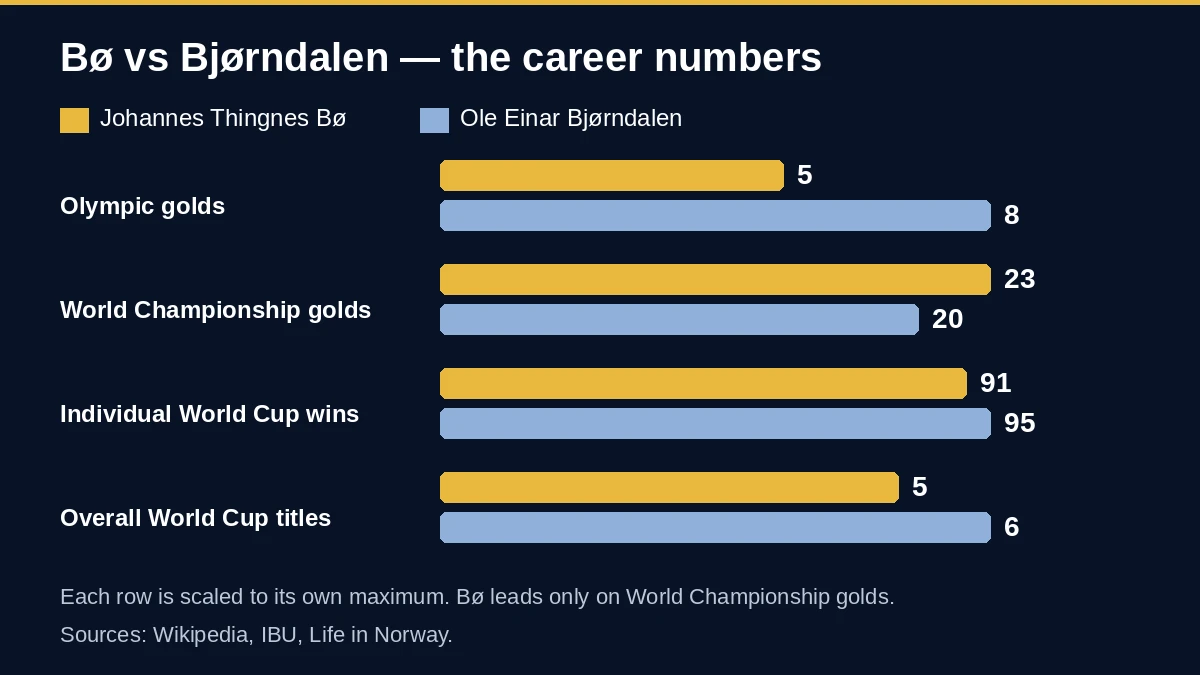
The season that defines him is 2018–19: back from a pre-season injury, he won six of the first eight individual races and finished with 16 individual wins — a record, beating Fourcade’s old mark of 14 — plus his first overall title and every globe. The next season he won his second overall title by two points over Fourcade in a COVID-shortened season’s final race. In 2022–23 he won 19 of the 25 individual races, including all eight sprints. In his final season, illness cost him the run-in and he finished second overall behind Lægreid, but still won the sprint globe.
The money: a record €477,000 season
Biathlon does not pay like football. Bø’s best season, 2022–23, is also the best-paid season any biathlete has ever had: €477,000 before tax. About €110,000 of it came at Oberhof alone. No biathlete had earned over €400,000 in a season before him; the previous season’s leader, Fillon Maillet, had earned €287,000.
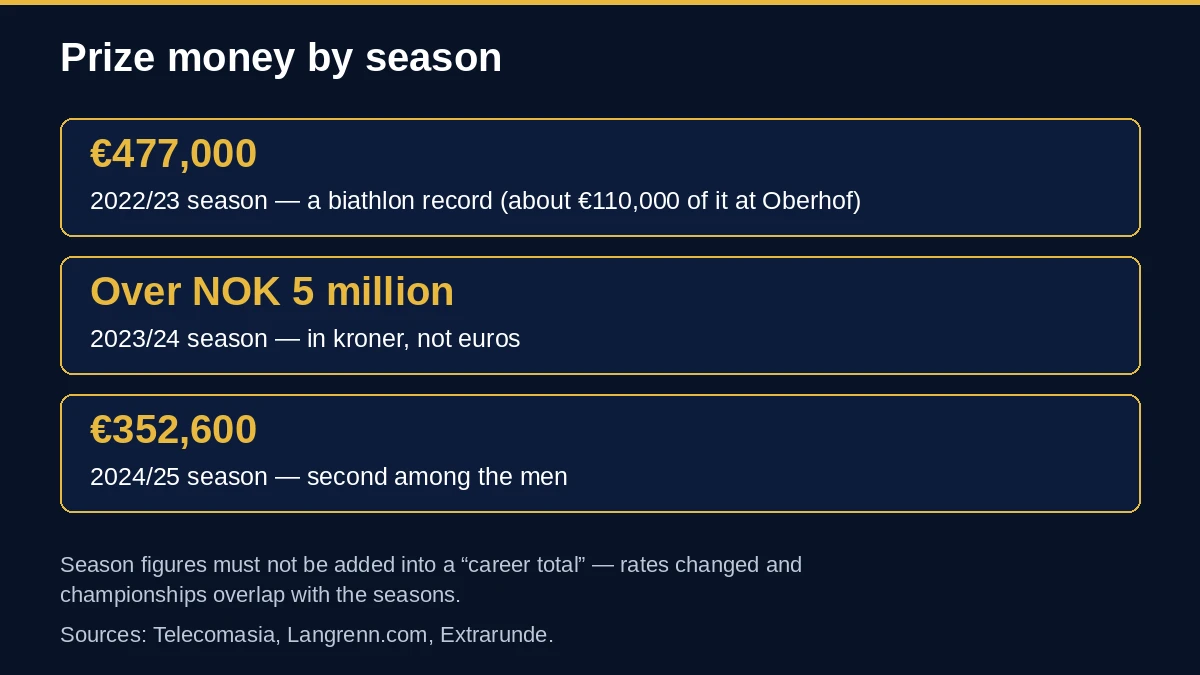
The seasons around it tell the same story, quieter. In 2023–24 he earned over NOK 5 million in prize money, from the World Cup and seven medals at Nové Město. In his final season, 2024–25, he earned €352,600, second among the men. The season figures cannot honestly be added into a “career total”: rates changed, championships overlap with seasons, and no verified career figure has ever been published. The season figures are the hard money; everything beyond them is sponsorship.
The tax lists: NOK 7.7 million — and what it is not
The tax lists are the only hard personal-wealth anchors for Bø. The latest verified figures are for the income year 2023, published in December 2024: income NOK 4,533,994, wealth NOK 7,737,415, tax NOK 1,537,236. He was the highest-earning Norwegian ski star that year, and the sixth-highest earner among Norwegian athletes. For scale, Klæbo’s tax-assessed wealth that year was NOK 25,691,641 — more than three times Bø’s.
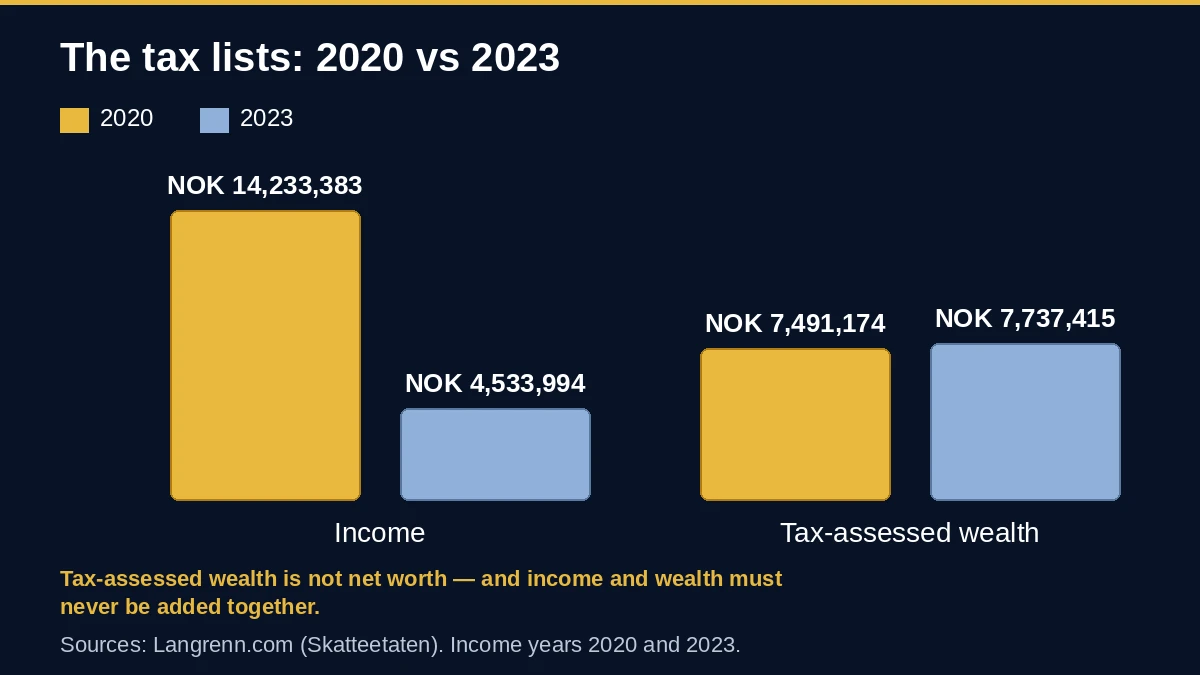
Earlier years show how lumpy an athlete’s income is. In 2020, Bø’s income was NOK 14,233,383 — more than three times his 2023 income — with wealth of NOK 7,491,174 and tax of NOK 6,026,450, making him the highest-earning winter-sport athlete that year.
First, tax-assessed wealth is not net worth: a tax construct — only a quarter of a home’s value up to NOK 10 million counts — and it must never be added to income, a flow, not a stock. Second, the 2024 lists were published in December 2025, but no Bø-specific figures were found in the outlets searched, so this article prints none; after the 2025 lists publish on 2 December 2026, refresh the figures. And the $10 million net-worth claim online sits next to a tax wealth of NOK 7.7 million — a tax figure, not a market value, from an aggregator with no source.
The family, and the brother who retired beside him
Born in Stryn on 16 May 1993, Bø married Hedda Kløvstad Dæhli in 2018. Their son Gustav was born in January 2020 — Bø took two weeks’ paternity leave mid-season and still won the overall World Cup — and their daughter Sofia was born in the summer of 2023. The family lives about 50 km outside Oslo.
His older brother Tarjei, born in July 1988, retired in the same month — announcing it on 24 January 2025 in Antholz, six days after Johannes, minutes after winning a sprint there, in tears in the mixed zone. Tarjei’s own career was formidable: seven Olympic medals (three gold), twelve World Championship golds from 28 medals, fifteen individual World Cup wins, and one overall title in 2010–11 by five points. His 2023 tax figures — income NOK 2,851,590, wealth NOK 52,703 — are his own, far smaller than his brother’s.
The watch, the wine bar and life after the snow
The most valuable sponsorship of his career is also the most visible: Richard Mille, the luxury watchmaker, has been his partner since January 2020, and he wears a bespoke RM 67-02. He recommended Klæbo to the brand — Klæbo joined as an ambassador in 2026. After retirement came two new partnerships: Adidas, revealed once the racing stopped, and Lapua, the precision-shooting brand. His equipment: Fischer skis, an Anschütz rifle, Julbo eyewear, Swix wax, plus Kinetixx, AF Gruppen, Jensen and Norsan. The names on the Norway team suit — ICE, Uno-X and Craft — are national-team sponsors, not personal deals.
He worked the Milano Cortina 2026 Winter Olympics as NRK’s biathlon expert, and in January 2026 received the honorary award at the Idrettsgallaen, Norway’s sports awards. His known business venture is Vingeriet, a wine bar and nightlife venue in Kongsvinger that he co-owns, opening in autumn 2026 — he has joked he may wait tables. No company accounts have been found for him, and no revenue or equity figure exists.
The fair summary: Johannes Thingnes Bø Net Worth 2026
So what is Johannes Thingnes Bø worth? Nobody has published a reliable figure, and this article will not invent one. What is documented is the shape of the money: a record €477,000 prize-money season, more than NOK 5 million the year after, €352,600 in his final season, the Richard Mille partnership, Adidas and Lapua deals, NRK work and the Vingeriet venture. Against that sits the only hard personal-wealth number on record: tax-assessed wealth of NOK 7,737,415 for 2023 — a tax figure, not a net worth, far below the $10 million an aggregator claims without a source.
A supposed Forbes figure of $2.3 million from 2021 also circulates, but no Forbes article exists behind it. He is not on Kapital’s 400 richest list, and no Norwegian outlet has published a net worth estimate. How wealthy, exactly, is a number nobody has published — and until Bø, Forbes or Kapital publishes one, any website offering a precise figure is guessing.
This article reflects information available on 6 November 2026. Net worth figures are estimates and are not confirmed by Bø or his representatives.
Related reading: our net-worth profiles of more Norwegian sports stars – Johannes Høsflot Klæbo, Therese Johaug, Karsten Warholm and Bjørn Dæhlie.
Sources & References
- Wikipedia: Johannes Thingnes Bø (career record, Olympic and World Championship results, World Cup statistics; secondary source)
- IBU: Johannes Thingnes Bø athlete profile (career record, 43 World Championship medals, 12 individual golds, family, home)
- IBU: Records in danger in 2024–2025 (91 individual wins vs Bjørndalen’s 95)
- Olympedia: Johannes Thingnes Bø (event-by-event Olympic results, Beijing 2022)
- Wikipedia: Tarjei Bø (brother’s record, retirement 24 January 2025)
- Wikipedia: 2024–25 Biathlon World Cup – Stage 9 (Holmenkollen finale: sprint win 21 March, pursuit 2nd, mass start 7th on 23 March)
- Sweden Herald: Johannes Thingnes Bø is retiring after the season (announcement 18 January 2025, Ruhpolding; family reason)
- Reuters: Bø relishes retirement as old foes bring biathlon drama (NRK expert at Milano Cortina 2026; no regrets about skipping the Games)
- Richard Mille: Johannes Thingnes Bø (12 individual World Championship golds; most decorated overall with 23 golds)
- WorldTempus: Richard Mille — Johannes Thingnes Bø, new partner (Richard Mille partnership, January 2020)
- MN2S: Johannes Thingnes Bø booking agency page (Lapua, Adidas, equipment list: Fischer, Anschütz, Julbo, Swix, Kinetixx, AF Gruppen, Jensen, Norsan)
- Telecomasia: Johannes Bø earns biathlon record €477,000 in prize money in one season (2022/23 record season, Oberhof €110,000, Fillon Maillet €287,000 comparison)
- Langrenn.com: 2023/24 prize money — over NOK 5 million (2023/24 season prize money)
- Extrarunde (Instagram): 2024/25 prize money (€352,600, rank 2 among men)
- Langrenn.com: Skistad tidoblet inntekten — tjente mest av skijentene (2023 tax figures for Johannes and Tarjei Bø; source: Skatteetaten, 4 December 2024)
- Langrenn.com: Så mye tjente idrettsstjernene våre i 2020 (2020 tax figures: income NOK 14,233,383, wealth NOK 7,491,174)
- Nordic Mag: Johannes Thingnes Bø opens his wine bar in Kongsvinger (Vingeriet, Kongsvinger, opening autumn 2026)
- Wikipedia: Ole Einar Bjørndalen (comparison figures: 95 World Cup wins, 20 World Championship golds, 6 overall titles)
- Life in Norway: Ole Einar Bjørndalen (13 Olympic medals incl. 8 gold; 95 World Cup wins; 6 overall titles)
- DNB: Skattelistene (2024 income-year lists published 3 December 2025; context only — no Bø figures found)
- Team Norway (Instagram): Idrettsgallaen hederspris (honorary award, January 2026)
- thecityceleb: Johannes Thingnes Bø biography (aggregator — $10M claim only; unverified, no methodology)
Disclaimer: Net worth figures for private individuals are estimates, not audited statements. This article is for information only and is not financial advice.