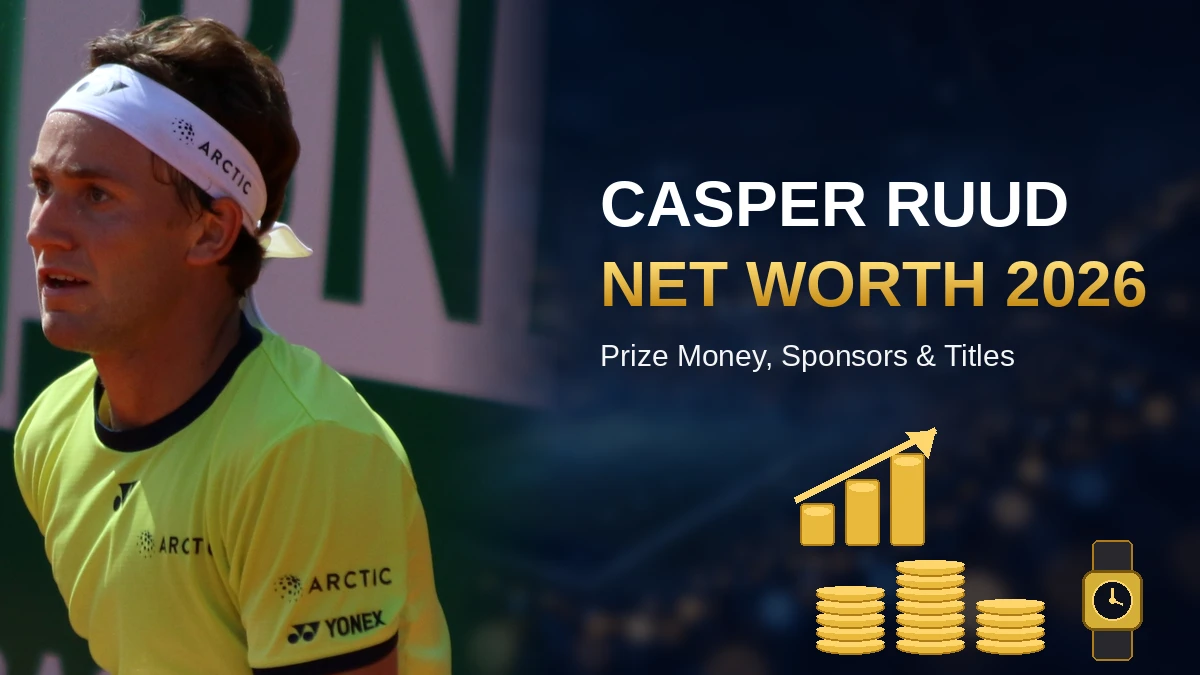

There is a particular kind of tennis career that pays very well without ever producing the one result that would make it famous. Casper Ruud has built exactly that career. He has reached three Grand Slam singles finals, finished a season as world No. 2, won fourteen ATP titles and collected close to $30 million in prize money — and he has never won a major. Nobody in the modern game has come that close, that often, without lifting the trophy.
That is why his money is such a tangled question. The on-court earnings are public, down to the dollar. Everything else — sponsors, investments, tax, the cost of keeping a tour career running — sits behind closed doors. The numbers in circulation range from $5 million to roughly NOK 550 million, and they are not really arguing about the same thing.
The short answer, with the argument attached
Casper Ruud’s net worth in 2026 is not publicly confirmed. No Forbes profile, no Kapital estimate and no filing gives a verified figure, and none of the numbers in circulation comes with a method you can check.
Here is what is actually out there. Celebrity Net Worth lists $5 million, a figure that appears not to have been updated since 2022. EssentiallySports put it at $12–15 million in May 2026. Norwegian press, via Dagbladet, has reported a figure around NOK 550 million — roughly $50–55 million at recent exchange rates, though that conversion is our own rough maths, not a published number. The Dagbladet figure’s methodology was not visible in the material available to us.
Set against those estimates is the one hard number in the whole picture: career prize money of $29,431,625, according to Wikipedia’s biography, which ranks him 20th all-time among men. That is gross money, paid before tax and before the cost of a coach, a physio, travel and an agent’s cut. It is not net worth, and treating it as net worth is the single most common mistake in this whole subject.
A few low-quality sites quote figures like $1.2 million or $4.7 million, with no sources at all. Both sit below his own career prize money, which makes them impossible on their face, so we disregard them.
Forbes gives a useful ceiling for his current income, even though it publishes no net worth for him. He did not appear among the ten highest-paid tennis players in Forbes’ 2026 list — tenth place, Elena Rybakina, earned $17.4 million — or in the 2025 list, where the cutoff was $14.3 million. Forbes counts prize money plus endorsements, before tax and fees, over twelve months, so his annual pre-tax income sits below those cutoffs. The Norwegian figure and the American figures cannot both be built the same way: NOK 550 million would be nearly double everything he has ever won on court, so it can only be right if sponsorships, investments and property are very large, and none of that is publicly documented.
The money, year by year
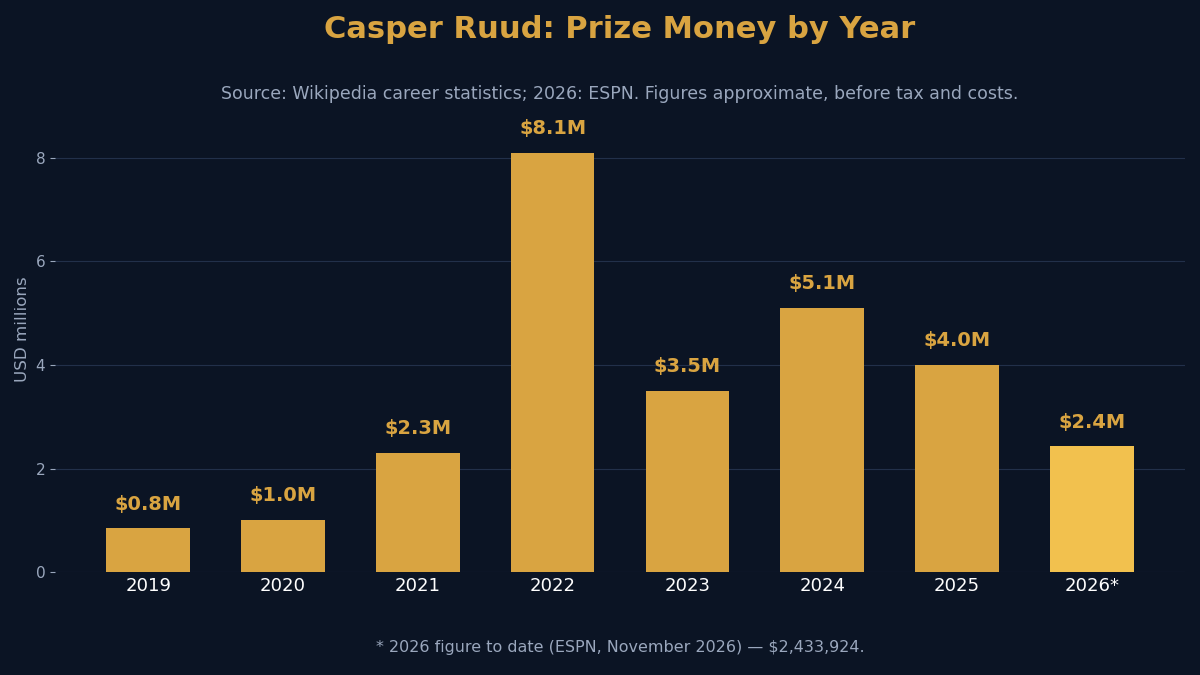
Prize money is the most reliable part of this story, and it is also the part that shows how uneven a tennis career is. Ruud’s first seasons paid almost nothing: $35,064 in 2016 and $223,662 in 2017. Then the climb began — $848,872 in 2019, $1,013,473 in 2020, $2,314,629 in 2021 — before the curve bent sharply upwards. (Yearly figures: Wikipedia’s career statistics page, which gives two different career totals, so treat every figure here as approximate.)
One year dominates the picture. In 2022 Ruud collected about $8.1 million, more than his previous six seasons combined. Everything after it looks like a comedown, and in prize-money terms it is: $3.5 million in 2023, $5.1 million in 2024, $4 million in 2025. A fortune built on a single peak year is valued very differently from one built on a decade of steady seasons, and that matters for the wealth question.
The 2026 figure deserves a note of its own. The live article listed $990,579 and flagged it as probably out of date — the Rome runner-up prize alone was €535,585, according to the ATP. ESPN now lists about $2,433,924 for the season, a total still in progress rather than a final number.
The season that made him rich
He reached the final of the French Open in June, losing to Rafael Nadal — the man he had grown up idolising — and then the final of the US Open in September, losing to Carlos Alcaraz. Between those two finals he rose to a career-high world No. 2 on 12 September 2022, and he closed the year as runner-up at the Nitto ATP Finals, losing to Novak Djokovic.
None of those finals produced a trophy, and that is the strange heart of his story. Three Grand Slam finals, three defeats, and a reputation as the best player of his generation never to win one. The money, though, does not care about the trophy cabinet: finalists at the majors earn most of what the winner earns, and two Slam finals plus a Tour Finals final in a single season is worth roughly $8 million before a sponsor pays a krone.
A third Grand Slam final followed at the 2023 French Open, again lost, this time to Djokovic. Then came the steadier, less spectacular seasons: the prize money eased, the ranking drifted, and the finals stopped arriving at the majors.
Madrid, Stockholm, and a Rome final
If 2022 was the year of the near-misses, 2025 was the year of the actual trophies. Ruud won the Madrid Open, a Masters 1000 event — the biggest title of his career — beating Jack Draper 7–5, 3–6, 6–4 in the final. He added the Stockholm Open indoors, beating Ugo Humbert 6–2, 6–3, and lost the Dallas Open final to Denis Shapovalov. His Grand Slam results that year were weaker, with second-round exits at all three majors he played, but he did reach the 2025 US Open mixed doubles final alongside Iga Świątek.

The 2026 season, up to the point this draft was written, followed a similar pattern: solid at the level below the Slams, short of a breakthrough at them. He reached the fourth round of the Australian Open and the French Open — in Paris he came through a five-set third-round win over Tommy Paul before losing in the fourth round to João Fonseca — and lost in the first round at Wimbledon to Hubert Hurkacz. His best result of the year was the Italian Open final in Rome, where he lost 6–4, 6–4 to Jannik Sinner.
Then came the injury that ended his Grand Slam year. He retired during the second set of his opening match at the Cincinnati Open against Christopher O’Connell, and on 30 August 2026 — the day the US Open began — he withdrew from the singles with a back injury, writing on Instagram that he and his team had decided to think long term. The ATP’s report notes he had played mixed doubles at Flushing Meadows earlier in the week with Diana Shnaider, losing in the quarter-finals, and that lucky loser Arthur Gea took his place in the draw. It was the first time he had missed the season’s final major since his professional debut at the tournament in 2017.
From Snarøya to No. 2
Ruud was born in Oslo on 22 December 1998 and grew up in Snarøya, in the Bærum municipality outside the capital. Tennis was the family business in the most literal sense: his father, Christian Ruud, is a former professional player, and his two sisters are Caroline and Charlotte. He was ranked world No. 1 on the junior tour on 4 January 2016.
The influences are the ones you would expect, and one you might not. Rafael Nadal was his tennis idol — the same Nadal who would beat him in his first Grand Slam final six years later — and he shares a love of golf with his father, a pastime that has followed him through his whole career.
There is a quieter point hiding in that background, and it matters for the money. Ruud grew up inside professional tennis, with a father who knew what the tour cost and what it paid — and players who arrive that way tend to run their careers like businesses earlier than most.
The sponsors, and what they don’t say
Ruud’s official sponsors page lists seven partners: Yonex for rackets and equipment, a partner since 2016; Samsonite, for whom he is a global brand ambassador; Renault; Salmar, the Norwegian aquaculture company; SuperOffice, the software firm; Fleming; and Formue, an investment firm. He is also an ambassador for the W Initiative, a humanitarian foundation.
What the page does not list is a single dollar figure. None of the deal values is public, and Forbes’ off-court estimates for other top earners run into the millions without telling us anything about what Ruud earns from any single sponsor. That silence is the whole problem with the net worth estimates: sponsorship is almost certainly his second-biggest income stream after prize money, and it is the one we know least about.
The same gap opens up around investments. A startup-investor directory, Nordic9, lists angel investments in SportAI and Recharge Health. The listing is unsourced, so we do not treat it as confirmed, and we found nothing else that documents his investing.

What we could not verify
Honesty about the gaps is the point of this article, so here they are, plainly. The net worth itself has no reliable, sourced figure. Sponsorship income is named but never priced. Investments rest on one unsourced directory listing. We found no verified details on his homes, cars or spending; he lives in Oslo with his partner and daughter. Norwegian tax treatment and team costs are not public, so net earnings cannot be estimated from the gross prize money. He and Maria Galligani announced their engagement in November 2024, and they welcomed a daughter in January 2026; we found no confirmation of a wedding.
Where that leaves it
Ruud’s on-court record is well documented: fourteen ATP titles, three Grand Slam finals and roughly $29 million in career prize money, with the season still adding to the total. His wealth is not. The gap between the cautious US estimates and the much larger Norwegian figure comes down to sponsorships, investments and costs that nobody has made public, and until a reliable source publishes a figure, the honest answer stays the same: his net worth is not publicly confirmed, and prize money is the one number you can trust.
The back injury that ended his 2026 Grand Slam season is the new variable: if he comes back and contends at the majors, the next few seasons could add several million more in prize money alone. If the injury lingers, the 2022 peak may stand as the financial high-water mark of his career.
This article reflects information available on 6 November 2026. Net worth figures are estimates and are not confirmed by Casper Ruud or his representatives.
Related reading: our net-worth profiles of more Norwegian sports stars – Magnus Carlsen, Viktor Hovland and Martin Ødegaard.
Sources & References
Career and prize money
- Casper Ruud, Wikipedia
- Casper Ruud career statistics, Wikipedia
- 2026 Italian Open men’s singles, Wikipedia
- Rome 2026 prize money, ATP Tour
- Ruud, Cilic withdraw from US Open, ATP Tour, 30 August 2026 (2026 US Open singles withdrawal, back injury, mixed doubles quarter-final with Diana Shnaider)
- ESPN player page (2026 season prize money $2,433,924)
Earnings and net worth estimates
- World’s highest-paid tennis players 2026, Forbes Australia
- World’s highest-paid tennis players 2025, Forbes Australia
- Casper Ruud net worth and career earnings, EssentiallySports
- Casper Ruud net worth, Celebrity Net Worth
- Dagbladet (NOK 550 million figure): read only through search excerpts; the site blocks automated access
Sponsors and investments
- Sponsors, casper-ruud.com
- Casper Ruud, Nordic9 (unverified listing)




[…] reading: our net-worth profiles of more Norwegian sports stars – Casper Ruud, Viktor Hovland and Martin […]
[…] reading: our net-worth profiles of more Norwegian sports stars – Casper Ruud, Magnus Carlsen and Aksel Lund […]
[…] Related reading: our net-worth profiles of more Norwegian sports stars – Martin Ødegaard, Alexander Sørloth and Casper Ruud. […]
[…] reading: our net-worth profiles of more Norwegian sports stars – Martin Ødegaard, Casper Ruud and Viktor […]
[…] Related reading: our net-worth profiles of more Norwegian sports stars – Erling Haaland, Martin Ødegaard and Casper Ruud. […]