


Anders Mol Net Worth 2026 is unconfirmed — no published income figure, no tax-list entry and no credible estimate exists for the Norwegian beach volleyball star, and this article will not invent one. What the record does show, in unusual detail, is a career built on winning: an Olympic gold medal, a world title, five European championships and four World Tour Finals victories, all of them with the same partner, Christian Sørum. The prize money from those wins is public, and it is listed here, win by win, because it is the only money in this story that can be written down with a source beside it.
Tokyo, 7 August 2021: the gold that started it
The final of the men’s beach volleyball tournament at the Tokyo Olympics was played on Saturday 7 August 2021 at Shiokaze Park, and it lasted 42 minutes. Mol and Sørum beat the Russian pair of Viacheslav Krasilnikov and Oleg Stoyanovskiy — competing as the Russian Olympic Committee — 2–0, 21–17, 21–18, the match ending on a serving error by their opponents. It was Norway’s first-ever Olympic medal in beach volleyball, and at an average age of 24, Mol and Sørum were the youngest men’s pair ever to win the title, as Volleyball World reported at the time.
There was nothing lucky about it. The Norwegians had been the world’s best pair for three years by then, and they played the final the way they had played the whole tournament: Mol, two metres tall, blocking everything at the net and serving hard enough to keep the Russians out of system, Sørum digging and setting with the calm of a man who had done it a thousand times. The Russians were the reigning world champions and the tournament’s top seeds, and they never led in the second set. When the last serve went into the net, Mol dropped to the sand. Norway had never won an Olympic beach volleyball match of any consequence before; now it had a gold medal.
It is worth remembering how young the pair were, because it explains everything that followed. Mol was 24, Sørum 25, and they had already been together for five years. Most beach volleyball partnerships last two or three seasons before splitting over money, results or personality. This one had been built slowly, by two men who grew up in the same small volleyball world and trusted each other completely. Tokyo was not a surprise ending. It was the payoff.
A family that lives volleyball

Anders Berntsen Mol was born on 2 July 1997 in Stord Municipality on Norway’s west coast, and grew up in Strandvik, a village small enough that volleyball was not a pastime but the family business. His father, Kåre Mol, played for the Norwegian national indoor team and is now his son’s coach. His mother, Merita Berntsen, played beach volleyball at the Atlanta Olympics in 1996 — the first Games at which the sport was on the programme. His brother Hendrik also plays, and all four Mol siblings have been active in volleyball. Anders is 2.00 metres tall and weighs 90 kilograms, and he plays for Dristug IL and Strandvik Sandvolleyballklubb, according to his Wikipedia biography.
The partnership with Sørum began in late 2016, their first event together in Klagenfurt in August of that year. Sørum, from the Oslo area, had been paired with Mol’s brother Hendrik before the switch, and the new pairing clicked almost immediately. By 2018 they were winning everything. There is a temptation in beach volleyball to credit one player — usually the blocker, usually Mol — but the pair’s own coaches have always described it the other way round: Mol’s blocking works because Sørum’s defence gives him the time to set up, and Sørum’s setting works because Mol’s serve puts the other team under pressure from the first ball. It is a system, not a star turn.
Mol has also played indoor volleyball when the calendar allowed, signing a temporary contract with Førde Volleyballklubb in 2019 and winning the Norwegian Championship with them in 2020. That indoor background matters: most beach players come from the sand alone, but Mol’s timing at the net and his comfort hitting from awkward positions come from years of playing six-a-side as a youngster. In August 2026 he announced he would return to the indoor game part-time, joining Italian SuperLega club Rana Verona for the 2026/27 season while still targeting a beach medal at the Los Angeles Olympics in 2028 with Sørum — a rare double career, and one that says plenty about how much he still enjoys playing.
Five European titles and a world crown
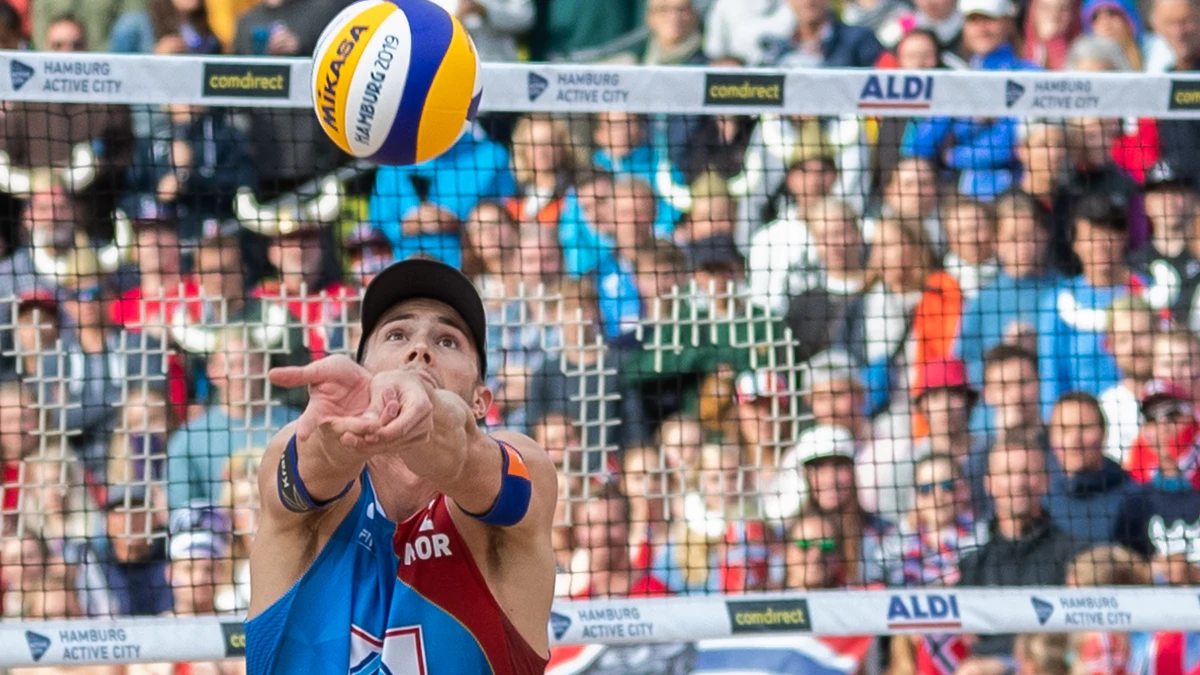
If Tokyo was the peak, the European Championships were the foundation. Mol and Sørum won their first European title in the Netherlands in 2018, defended it in Moscow in 2019, won again in Jūrmala, Latvia in 2020, and made it four in a row in Vienna in 2021 — the first team ever to win four consecutive European titles. They did not win in Munich in 2022, taking bronze after losing their semi-final to Sweden’s David Åhman and Jonatan Hellvig, who went on to win gold. They finished fifth in 2023 and did not play the event in 2024. Then, in Düsseldorf in 2025, they won it for a fifth time, beating Åhman and Hellvig in the final in a tie-break — and they did it without losing a match in any of their five title campaigns, 31 wins in all, as the European championship history records.
The world title came in Rome in June 2022. Mol and Sørum beat Brazil’s Vitor Felipe and Renato Lima 2–0, 21–15, 21–16, in the final at the Foro Italico on 19 June 2022, becoming the youngest team ever to hold the Olympic and world titles at the same time — Mol was 24, Sørum 26. It was the title that had eluded them three years earlier in Hamburg, where they had lost their semi-final to Germany’s Julius Thole and Clemens Wickler and then beaten the Americans Tri Bourne and Trevor Crabb 2–1, 19–21, 21–15, 15–10, in the bronze-medal match on 7 July 2019. Hamburg was the first world medal; Rome was the completion of the set. The Volleyball World report from Rome called them “unstoppable”, and on that week they were.
They could not defend the world title in Tlaxcala, Mexico, in 2023, losing in the quarter-finals to the Czech pair of Ondřej Perušič and David Schweiner, who went on to win the championship. It was a reminder that in beach volleyball, where a single bad set can end a tournament, no dominance lasts forever. The Swedes, Åhman and Hellvig, had by then become the pair everyone measured themselves against, and the rivalry between the two teams — Norway against Sweden, the old guard against the new — has defined the sport’s last four years.
Paris bronze, and the long 2025
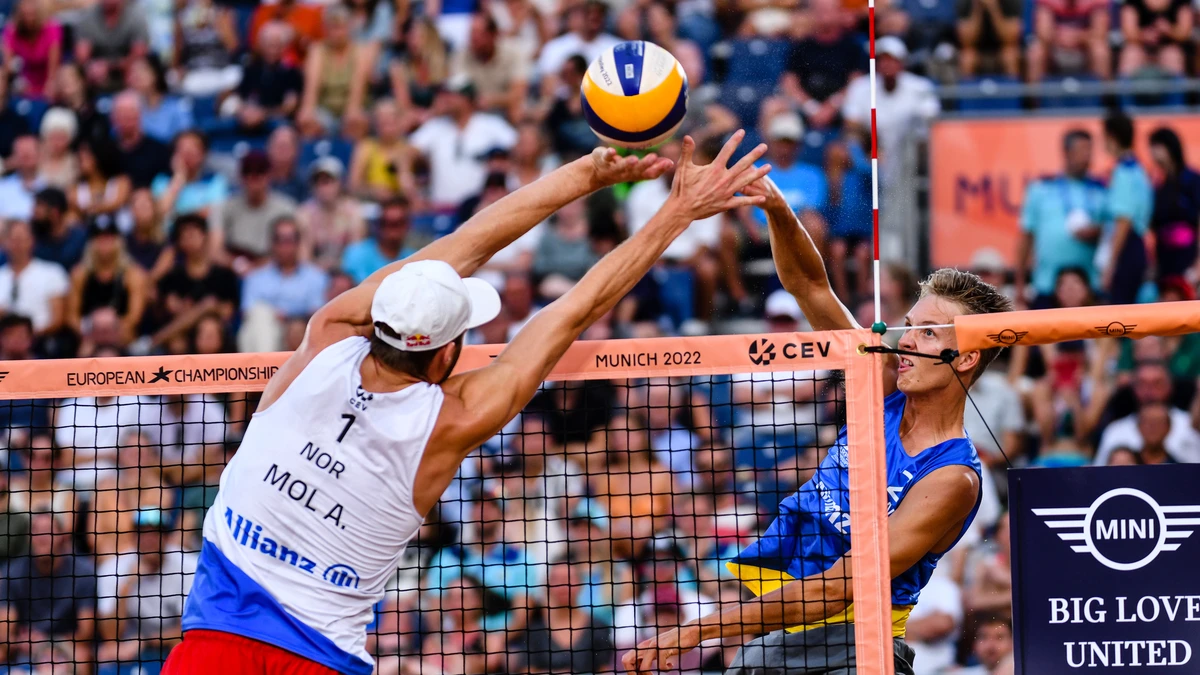
Paris 2024 was supposed to be the defence of the Tokyo title. It ended with a bronze, and the way it ended said something about how the sport had changed. In the semi-final on 8 August 2024, Mol and Sørum lost 2–1 to Germany’s Nils Ehlers and Clemens Wickler, 21–13, 17–21, 15–13, at the Eiffel Tower Stadium. Two days later they beat Qatar’s Cherif Younousse and Ahmed Tijan 2–0, 21–13, 21–16, in the bronze-medal match on 10 August. The gold went to Åhman and Hellvig. A bronze at an Olympics is a fine result by any measure, but for a pair who had won gold in Tokyo, it was a step down, and they knew it.
The response was a long, strong 2025. They won Elite16 titles in Saquarema, Montreal and Hamburg, took silver in Ostrava and bronze in Brasília, and finished the year as world number one. The fifth European title in Düsseldorf was the highlight, and Mol collected two individual awards for the season: Beach Pro Tour Offensive Player of the Year and Blocker of the Year, the fifth time he had won the blocking award. The one disappointment was the World Championships in Adelaide in November 2025, where they went out in the round of 16, losing 2–1 to Ehlers and Wickler again — 16–21, 21–18, 16–14, on 20 November 2025. The Germans, it seemed, had their number. The 2025 season is covered in detail by CEV’s review of the year.
Through all of it, the partnership has held. Ten years together, an Olympic gold, a world title, five European titles and four World Tour Finals wins is a record no other men’s pair in the sport’s history can match for consistency, and it has been built on something unfashionable: staying together. In a sport where pairs split after one bad season, Mol and Sørum have simply kept going, and the results have kept coming.
What the winning actually paid
Beach volleyball is unusual among Olympic sports in that its prize money is published, event by event, and the figures below are the winners’ shares for the pair — the amount Mol and Sørum split between them — taken from contemporary reports. In Hamburg in 2018, their first World Tour Finals win brought them $150,000, a purse so large at the time that it set a record for the sport, as VolleyMob reported. They won the same event again in Cagliari in 2021, taking home another $150,000 after beating Perušič and Schweiner 22–20, 23–21, in the final, according to VolleyballMag’s report. The world title in Rome in 2022 paid $60,000 to the winners, with $45,000 for the runners-up and $35,000 for bronze, as VolleyballMag reported from the final. And their fourth World Tour Finals win, at the Beach Pro Tour Finals in Doha in 2024, paid $150,000, as Sandcast reported.
Four cheques, four verified figures: $150,000, $150,000, $60,000 and $150,000. It is tempting to add them up and call the total his career earnings. That would be wrong, and this article will not do it. Those four wins are only the biggest cheques; across a decade at the top, Mol and Sørum have won dozens of smaller events, each with its own prize money, and no source publishes a career total for either man. The FIVB does not publish one. No Norwegian newspaper has calculated one. Adding four numbers together and presenting the sum as “career earnings” would be inventing a figure, not reporting one.
The same honesty applies to everything else. No salary figure for Mol has been published. Beach volleyball players are not salaried in the way footballers are; their income is prize money, federation support, and whatever sponsorship they can arrange, and none of those numbers is public for Mol. No Norwegian tax-list income or wealth figure for him has been published either — the official tax-list search is run by the Norwegian Tax Administration and requires logging in, as the Skatteetaten tax-list page states. One low-quality website claims a net worth of “$1 million to $5 million” for him, with no source at all; it is not used here and should not be quoted anywhere. The verified money in this article is the prize money above, and it is all there is.
The fair summary: Anders Mol Net Worth 2026
Anders Mol Net Worth 2026 is unconfirmed, and after a decade of winning, that is still the honest position. He is 29 years old, an Olympic champion, a world champion, a five-time European champion and a four-time World Tour Finals winner, and the verified prize money from his four biggest wins comes to $150,000, $150,000, $60,000 and $150,000 per team — shared with Christian Sørum, and never to be added up into a pretend career total. There is no published salary, no published sponsorship value, no published tax-list income or wealth figure, and no credible estimate to quote, so there is no net worth number in this article. What is certain is the sporting record, and it is one of the finest in the history of beach volleyball.
Sources & References
- Volleyball World — Mol-Sørum claim Tokyo Olympic title: https://en.volleyballworld.com/beachvolleyball/competitions/olympics-2020/news/mol-sorum-claim-tokyo-olympic-title
- Volleyball World — Unstoppable Mol and Sørum lift World Championships trophy (Rome 2022): https://en.volleyballworld.com/beachvolleyball/competitions/beach-volleyball-world-championships/2022/news/unstoppable-mol-and-sorum-lift-world-championships-trophy
- CEV — European Beach Volleyball Championships history: https://eurobeachvolley.cev.eu/en/history/
- CEV — 2025 belonged to them: Europe’s beach volleyball heroes: https://cev.eu/articles/features/2025-belonged-to-them-europe-s-beach-volleyball-heroes/
- VolleyMob — Norway’s Anders Mol, Christian Sørum win World Tour Finals gold (2018, $150,000): https://volleymob.com/norways-anders-mol-christian-sorum-win-wtfinals-gold/
- VolleyballMag — Mol-Sørum win FIVB World Tour Finals gold, Cagliari 2021 ($150,000): https://volleyballmag.com/fivb-world-tour-finals-101021/
- VolleyballMag — 2022 World Championships final report, Rome ($60,000 winners): https://volleyballmag.com/pro-beach-volleyball-061922/
- Sandcast — Anders Mol, Christian Sørum reclaim Beach Pro Tour Finals title, Doha 2024 ($150,000): https://sandcastvolleyball.com/anders-mol-christian-sorum-deliver-statement-in-reclaiming-beach-pro-tour-finals-title/
- Volleyball World — Perušič and Schweiner take Czechia to the top of the world (Tlaxcala 2023): https://en.volleyballworld.com/beachvolleyball/competitions/beach-volleyball-world-championships/2023/news/perusic-and-schweiner-take-czechia-to-the-top-of-the-world
- Xinhua — Paris 2024 beach volleyball bronze-medal match report: https://english.news.cn/20240811/3e48488f536d4126b115bfed2f9d8e29/c.html
- Wikipedia — Anders Mol (biography, career record): https://en.wikipedia.org/wiki/Anders_Mol
- Skatteetaten (Norwegian Tax Administration) — Search the tax lists: https://www.skatteetaten.no/en/forms/search-the-tax-lists/