


In August 2026, E24 reported that Sigrid’s company, Sala Music AS, had taken in about NOK 31 million in revenue in 2025 — roughly triple the year before — and posted a net profit of about NOK 8.4 million. It was a sharp rebound for a business whose revenue had fallen for two straight years, and it arrived in the same year as her third album.
Those are company figures, not her personal fortune. The distance between the two is the whole subject of this article: what the public record actually shows about Sigrid’s money, where it runs out, and why the only dollar figure in circulation looks far too small next to the Norwegian data.
The number that isn’t there
Sigrid’s net worth is not publicly confirmed. There is no Forbes net-worth profile for her and no Kapital estimate, and her personal tax-list figures could not be retrieved. That leaves three kinds of evidence, measuring different things.
The first is the online estimate. TheCityCeleb’s figure is about USD 1.3 million as of 2023, with no method shown. It predates her latest results by two years, and no better-sourced estimate exists to compare it against. A figure with no method and no update is a placeholder other sites keep repeating because nothing has replaced it.
The second is the company accounts. E24 reported in 2024 that Sigrid owns 100% of Sala Music, and at the end of 2024 equity stood at NOK 13.8 million. The 2025 net profit of about NOK 8.38 million might raise it, but E24’s 2026 article gives no 2025 equity or dividend figures. If no dividend was paid, equity would sit near NOK 22 million — arithmetic, not a verified number.
The third is her investments. According to that same E24 article, her market-based investments come to roughly NOK 16 million, including stakes in Sparebanken Norge and SpareBank 1 SMN, and the portfolio has doubled. But it does not say whether she holds them personally or through the company, so they cannot simply be added to company equity. NOK 16 million is roughly USD 1.5 million at about NOK 10 to 11 per dollar — our approximation; we did not verify a rate.
The honest reading is uncomfortable in both directions. USD 1.3 million looks low next to a company with NOK 13.8 million in equity and a reported NOK 16 million portfolio — but no source supports a specific personal figure, and the overlap between the two is unknown. Treat her net worth as unconfirmed, and the USD 1.3 million as stale, not as fact.
A company that breathes with the album cycle
Sala Music AS is the clearest window into how Sigrid earns: the accounts are public and follow her creative cycle almost exactly. Figures are in NOK, from VG and E24.
Revenue was NOK 7.2 million in 2017 and more than doubled to NOK 16.2 million in 2018, the year after “Don’t Kill My Vibe”. No profit figures were found for either year, and none for 2019 to 2021 — a gap in the record, not in her career.
The peak came in 2022, the year How to Let Go was released: revenue of NOK 38.9 million and a pre-tax profit of NOK 9.3 million. Then the fall: NOK 25.9 million in 2023 (pre-tax profit NOK 5.4 million, dividend NOK 0.5 million), and NOK 10.1 million in 2024 — though the company still made a net profit of NOK 1.4 million and paid a dividend of NOK 169,000.
Then 2025: revenue of about NOK 31 million, an operating result of about NOK 8.57 million and a net profit of about NOK 8.38 million. Revenue roughly tripled in the year her third album, There’s Always More That I Could Say, arrived.
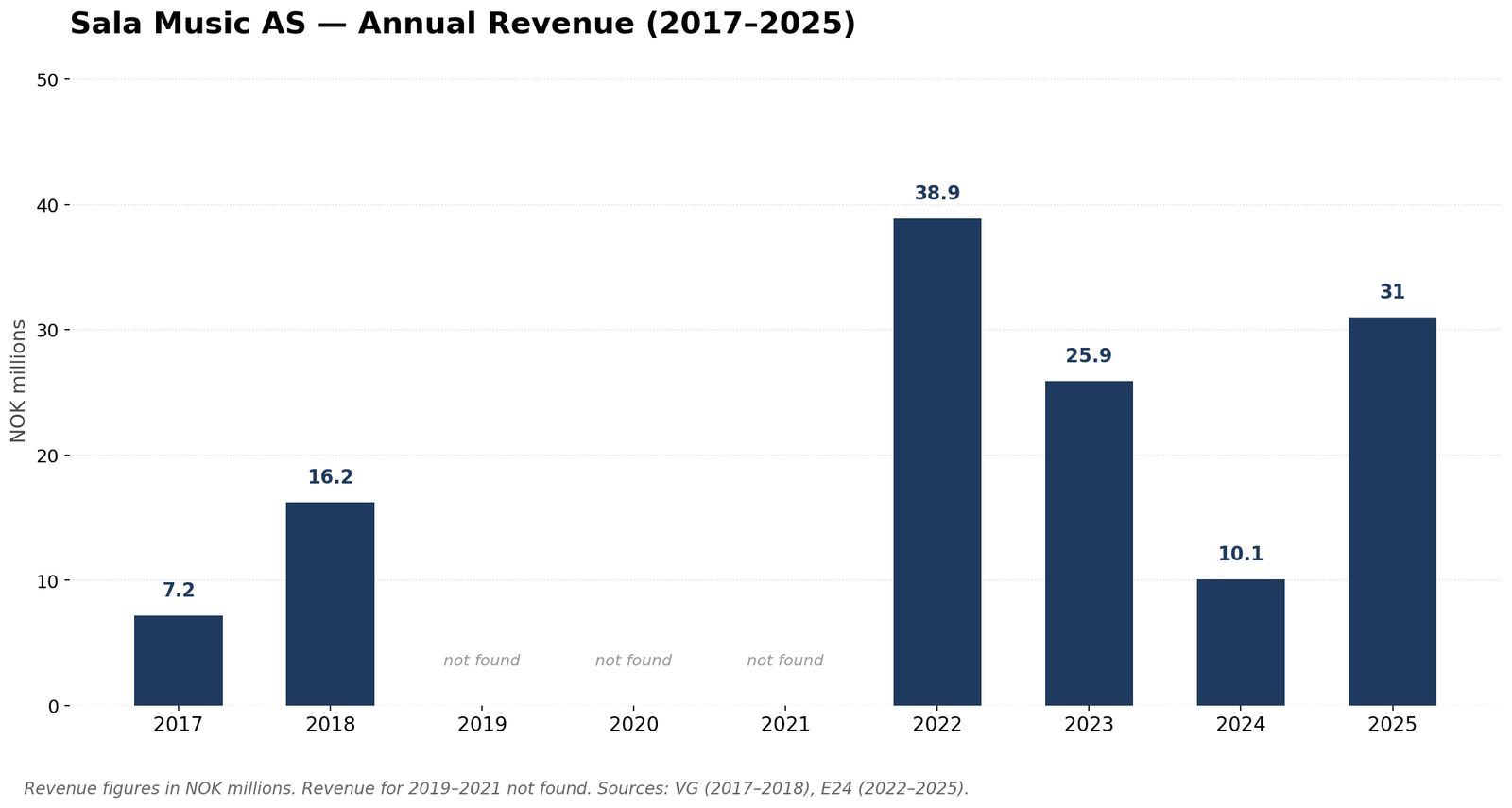
Revenue peaks in album years and sags between them. What matters more is the sag years: the company stays profitable. In 2024, revenue dropped by more than half and Sala Music still made money — the difference between a business built on one tour and one built on a catalogue, where streaming and publishing keep paying even with no new record to sell.
Profit tells a more careful story than revenue. The 2025 operating result of about NOK 8.57 million on about NOK 31 million of revenue implies a margin of roughly 28%, by our own arithmetic from E24’s figures — a healthy margin for a small music company.
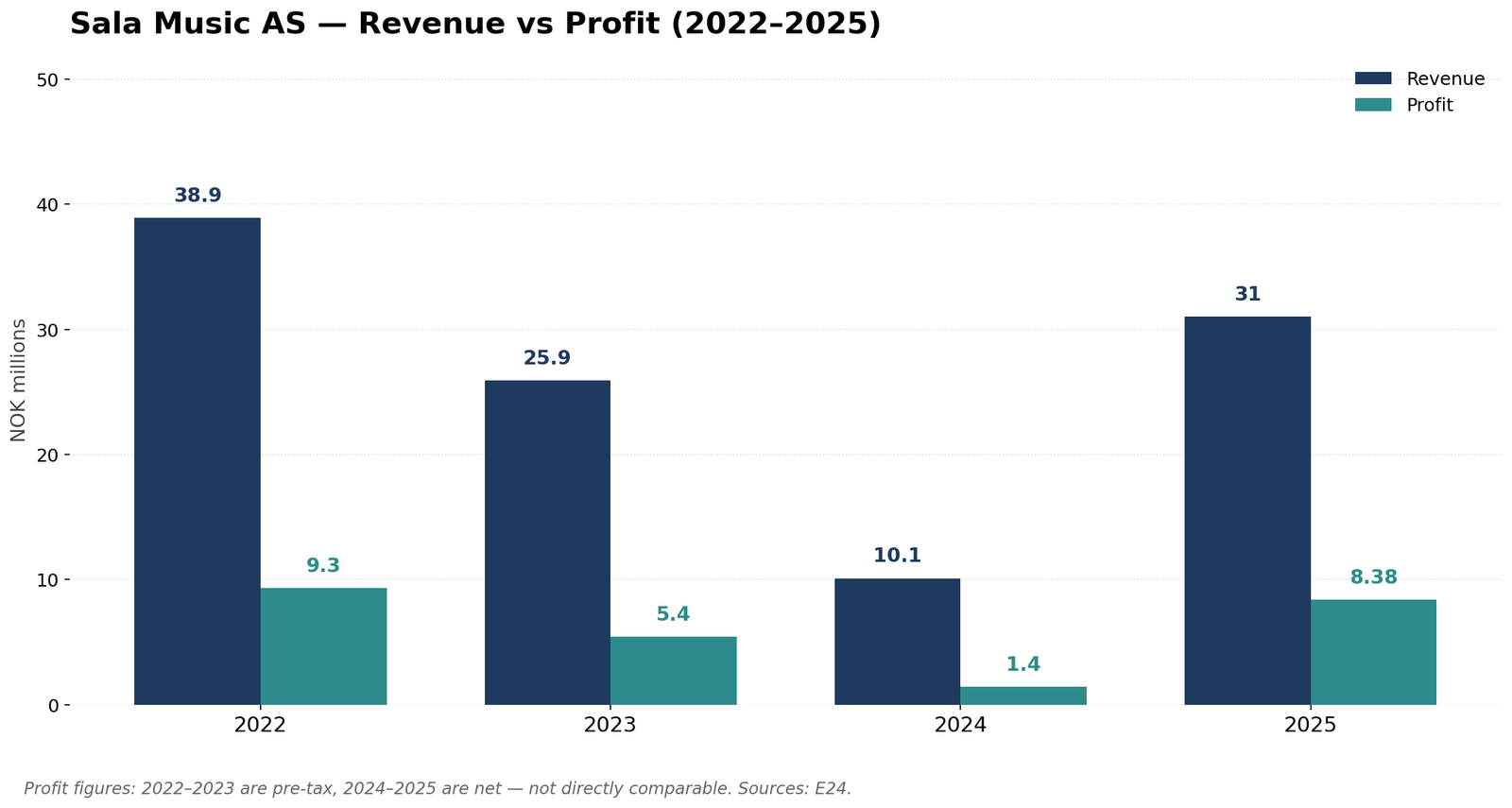
The reports do not split revenue by source. Nothing in the coverage explains how much came from touring, streaming or publishing, or why the swings are so large. The cycle is visible; its engine is not.
Dividends have been small: NOK 0.5 million for 2023, NOK 169,000 for 2024, nothing reported for 2025. Because she owns the company outright, retained profit stays inside it — which is why company equity, not salary or dividends, is the better clue to her wealth, and also why it is only a clue. Equity is not cash in her bank account, and it is not a net worth until someone values the whole business, debts and all.
What NOK 16 million in the market means
The most concrete personal-finance detail in the public record is not a salary or a house but the reported investment portfolio: roughly NOK 16 million in market-based investments, including stakes in Sparebanken Norge and SpareBank 1 SMN, a portfolio E24 says doubled.
Two things make that detail worth pausing over. The first is what it says about how she handles money: a pop star whose wealth sits in bank shares rather than property or cars is, so far as the record shows, a quiet and conventional investor — no reported startups, no fashion label, no restaurant chain. The second is what it does not say. E24 does not make clear whether those investments sit inside Sala Music or in her own name. If they sit inside the company, they are already part of its equity, and adding NOK 16 million to NOK 13.8 million would count the same money twice. Until that is clarified, the honest thing is to report both numbers side by side and refuse to add them.
That is exactly where most net-worth articles go wrong: they add every number they can find into a total no source supports.
One more gap worth naming: no verified property purchases, lifestyle spending or other business ventures were found for Sigrid. That does not mean they do not exist — the public record is simply silent, and silence is not evidence either way. A singer who keeps her private life out of the press will always look poorer on paper than one who posts about every purchase, which is a reason to be careful, not to invent.
The brand deal nobody priced
Wikipedia lists Sigrid as a brand ambassador for Gore-Tex. The terms of that partnership are not public, so its value cannot be estimated — and it has not been estimated here.
It is a small detail, but it says something about her commercial profile: on the public evidence, she is not a singer whose income depends on endorsements — no long list of fashion campaigns, no reported seven-figure brand contract. Her money, so far as anyone can document it, comes from music. That may change, but as of the latest reporting, one named partnership with no price attached is all that can responsibly be said about it.
From Ålesund to the BBC Sound of 2018
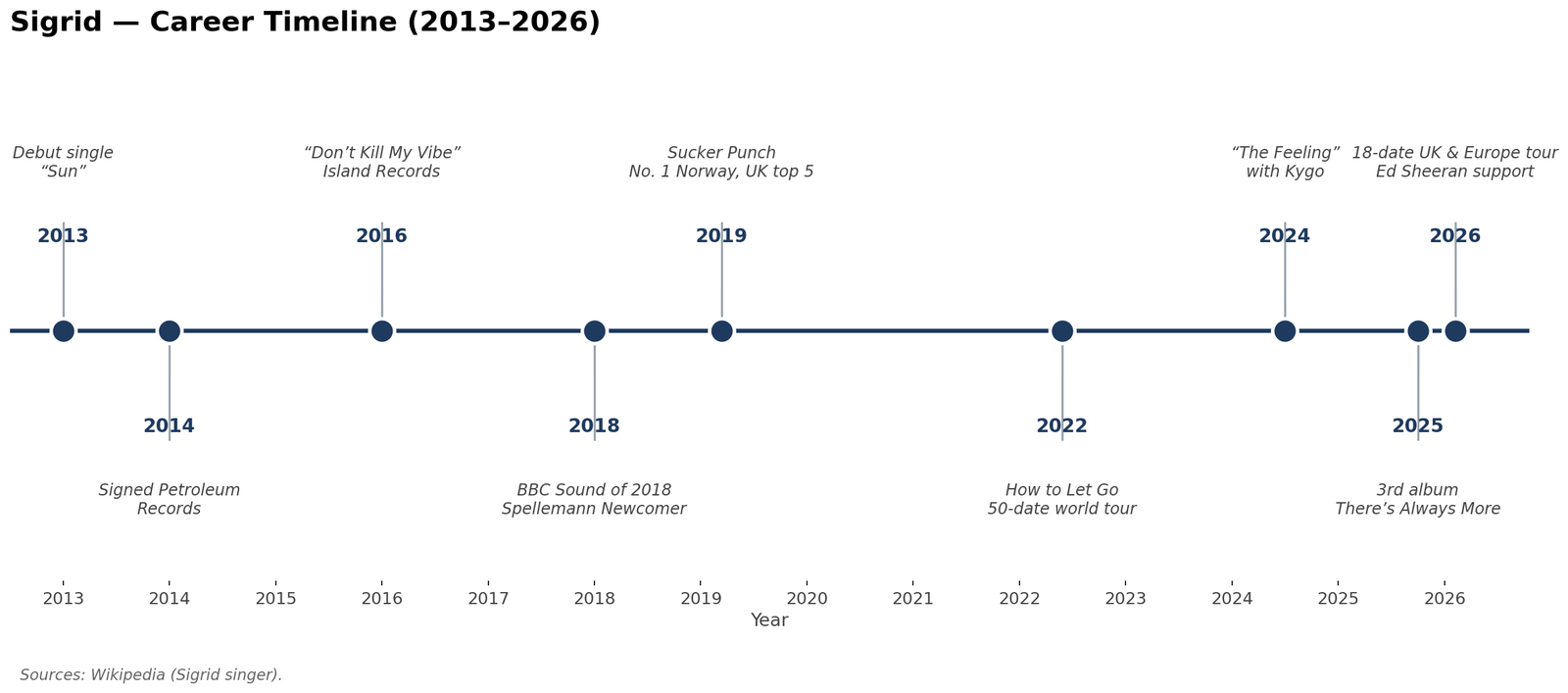
The money story only makes sense against the career that produced it, and Sigrid’s has the shape of a slow build followed by a sudden lift. She was born Sigrid Solbakk Raabe on 5 September 1996 in Ålesund, on Norway’s west coast. Per Wikipedia, she began piano at seven and singing at 13, finished high school in Ålesund, then moved to Bergen for its indie scene.
She studied comparative politics at university but dropped out to pursue music, wrote her first song, “Sun”, at 16, released it as her debut single in 2013, and signed with Petroleum Records in 2014 — a Norwegian label, a small start, no sign yet of what was coming.
The turning point came in 2016, when she co-wrote “Don’t Kill My Vibe” with Martin Sjølie. The song brought her an Island Records deal and gave her 2017 EP its title. In January 2018 she won the BBC Sound of 2018 poll, the BBC’s annual tip for the year ahead. She also took Newcomer of the Year at Norway’s Spellemann Awards that year.
March 2019 brought her debut album, Sucker Punch, which topped the Norwegian chart and reached the top five in the UK. She was named to Forbes’ 2019 Europe 30 Under 30 list in entertainment — a recognition list, not a wealth valuation. How to Let Go followed in May 2022 and repeated the feat: No. 1 in Norway, top five in the UK, then a 50-date world tour across 2022 and 2023.
That tour is the bridge between the career story and the accounts: the 2022 peak is the year the album came out and the tour began; the fall in 2023 and 2024 is the long quiet after it. Then came “The Feeling” with fellow Norwegian Kygo in June 2024, and “Jellyfish” in July 2025, the first single from her third album. There’s Always More That I Could Say followed in October 2025 — and Sala Music’s revenue tripled in the same year.
The 2026 tour, and the stages after it
In 2026 she headlined an 18-date UK and European tour from January to March, ending at Barrowland Ballroom in Glasgow. Wikipedia also lists her as a support act on Ed Sheeran’s Loop Tour this year, putting her in front of stadium audiences her own headline shows never reach.
Both matter for the wealth question, though neither can be priced: a headline tour is where a pop star’s company makes its money, and a support slot is where the next audience comes from. If the pattern holds, the 2026 figures should show another strong year — but that is a prediction, not a fact.
The business is in better shape than at any point since 2022, the artist behind it is 30 and on her third album, and the next accounts will test whether the rebound was a one-year spike or a steadier run.
Where that leaves it: Sigrid Net Worth 2026
Sigrid’s finances show a business that tracks her creative cycle almost exactly. Revenue peaked in 2022, sank in 2024 and recovered strongly in 2025, while the company stayed profitable throughout and paid little out in dividends. A reported NOK 16 million investment portfolio points to meaningful wealth beyond the company, but the overlap is unclear and her tax-list figures are missing.
A personal net worth is what the public record cannot provide. Company equity, an investment portfolio and a profitable 2025 all point in the same direction — up — but from different places, and adding them together would be inventing a number, not discovering one. The USD 1.3 million estimate from 2023 looks low against the Norwegian data, but “higher than USD 1.3 million” is not a net worth either.
Until Sigrid, Forbes or Kapital publishes a figure, the fairest statement is the simplest: her net worth is not publicly confirmed. What is confirmed is the shape of the business behind it — a small, wholly owned company that makes money when she releases music, keeps making money when she doesn’t, and has just had its best year since 2022.
This article reflects information available on 13 October 2026. Net worth figures are estimates and are not confirmed by Sigrid or her representatives.
Related reading: our net-worth profiles of more Norwegian musicians – Astrid S, AURORA and Dagny.
Sources & References
- E24: Dro inn 31 millioner (2025 accounts and investments, August 2026)
- E24: Kraftig inntektsfall for Sigrid (2024 accounts, 4 July 2025)
- E24: Fall i inntektene for Sigrid (2023 accounts, ownership, 3 July 2024)
- VG: Sigrid Solbakk Raabe økte inntektene med ni millioner i 2018 (5 August 2019)
- SMP: Så mye dro hun inn i inntekter (headline: income tripled, 6 August 2026)
- Wikipedia: Sigrid (singer) (biography, discography, tours; secondary source)
- TheCityCeleb: Sigrid biography and net worth estimate (online estimate)
Disclaimer: Net worth figures for private individuals are estimates, not audited statements. This article is for information only and is not financial advice.




[…] reading: our net-worth profiles of more Norwegian musicians – Astrid S, Sigrid and Anna of the […]
[…] reading: our net-worth profiles of more Norwegian musicians – Sigrid, Dagny and Girl in […]
[…] reading: our net-worth profiles of more Norwegian musicians – Sigrid, Girl in Red and Alan […]