

Morten Abel Net Worth 2026 is unconfirmed — no published income figure, no tax-list entry and no credible estimate exists for the Norwegian singer-songwriter, and this article will not invent one. What can be verified is a career of more than four decades across almost every corner of Norwegian popular music: a teenage singer in a Stavanger dialect-rock band, the frontman of one of the country’s biggest pop-rock groups of the early nineties, a solo star whose English-language albums all reached the Norwegian Top 5, and, at sixty-three, a painter, novelist, actor and festival artist still releasing records.
Bodø, Stavanger, and a band that had to change its name
Morten Abel Knutsen was born on 15 October 1962 in Bodø, in northern Norway, and lived there until he was fifteen, when his family moved south to Stavanger. The move decided his life. In Stavanger he auditioned for a band called Catrix, and when the name would not do, he had it changed to Mods, inspired by the film Quadrophenia and its music by The Who. He was still a teenager, singing in the broad Stavanger dialect. The early story is set out in the Store norske leksikon and on his English Wikipedia biography.
Mods became one of the defining bands of the Stavanger scene. They released two albums in Norwegian, Revansj! in 1981 and Amerika in 1982, with their biggest Norsktoppen hits “Tore Tang” in 1981 and “Fint at du vil” in 1982, and a third album, Time Machine, in English in 1984. The band was over by the mid-eighties, but in Stavanger it never really went away. The band’s history is recorded on the Norwegian Wikipedia page for Mods.
Mods: the reunion that filled a football stadium
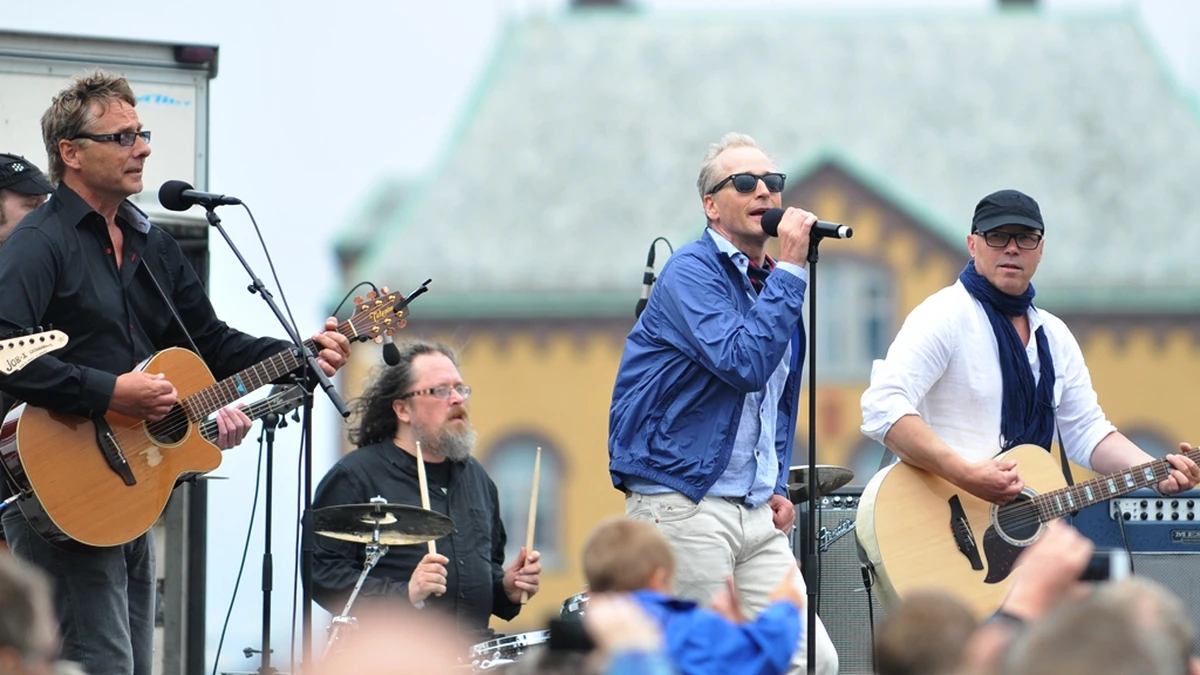
In December 2011 the band announced a reunion concert at Viking Stadion in Stavanger, and in June 2012 nearly 25,000 people turned up — a sold-out football stadium for a band that had last played together when its singer was twenty-one. A live album, Live Viking stadion 9. juni 2012, followed three weeks later and reached number three on the Norwegian albums chart. The reunion is documented on the Norwegian Wikipedia page for Mods.
The September When: the band that made him a national name
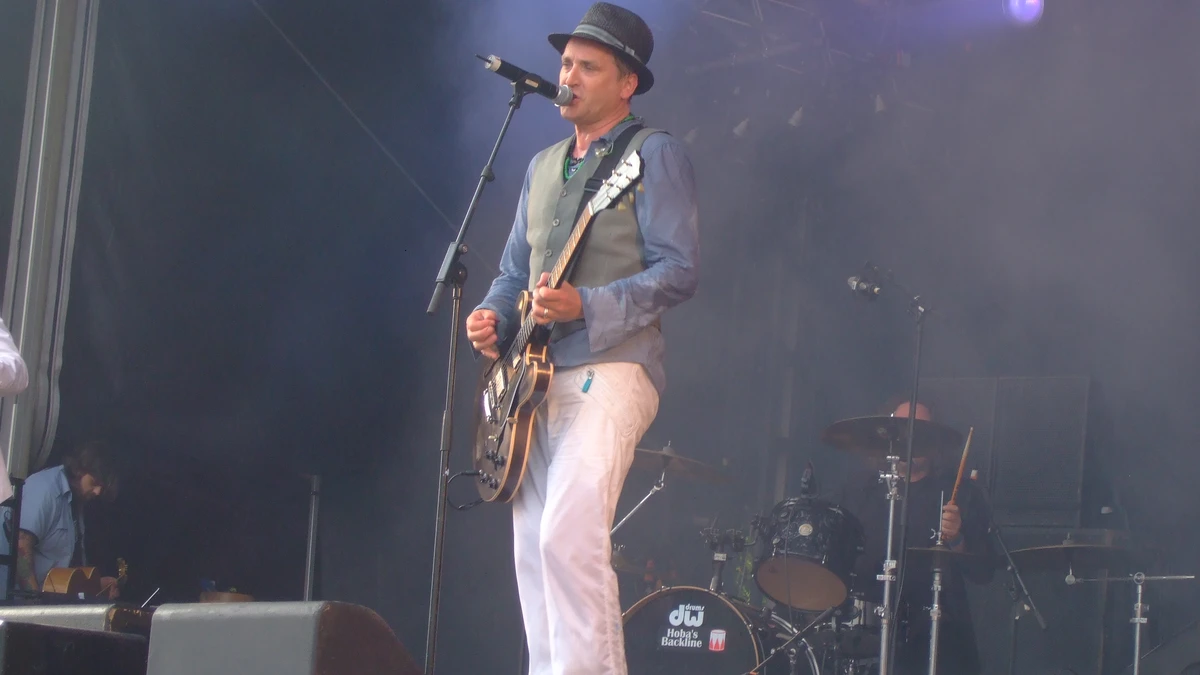
After Mods split, Abel released a solo single in 1985, “It’s Your Life” backed with “See You Around, Peter”, under the name Abel Knutsen. Two years later he formed a new band with two former Mods members, Helge Hummervoll and Tor Øyvind Syvertsen. They called it The September When, sang in English this time, and became one of Norway’s most popular pop-rock groups of the first half of the nineties. Their four studio albums came in quick succession: The September When in 1989, the bestseller Mother I’ve Been Kissed in 1991, One Eye Open in 1993 and HuggerMugger in 1994. The band’s story is told in the Store norske leksikon.
Their singles — “Bullet Me”, “Where You Go I Go”, “Can I Trust You?”, “Cries Like A Baby” and “Don’t Call The Cops” — all reached the Top 15 on the VG-lista. The band split in 1996. Between bands he fronted a trio, Peltz, whose only album, Coma (1996), reached number two in Norway. The September When came back in the autumn of 2008 with Judas Kiss, and was put on ice again in 2009. Guitarist Morten Mølster died in January 2013. In 2019 the band rose again with two new guitarists, Geir Sundstøl and Nikolai Grasaasen, and in 2025 it released HuggerMugger Live 2024.
Snowboy and the solo run that topped the charts
The real solo career started in 1997 with Snowboy, produced by Abel with Knut Bøhn and Glenn Rosenstein. It was followed by Here We Go Then, You and I in 1999, I’ll Come Back and Love You Forever in 2001, the first album co-produced with Børge Fjordheim, Abel’s regular drummer, and Being Everything, Knowing Nothing in 2003. A double compilation and a live DVD arrived on 29 November 2004, and Abel toured Norway with Lene Marlin and Bertine Zetlitz behind it. His fifth studio album, Some of Us Will Make It, came out in Norway on 27 November 2006. The sequence is set out on his Norwegian Wikipedia biography.
Every one of his English-language solo albums reached the Top 5 in Norway. The second album, Here We Go Then, You and I, stayed in the Top 40 for 56 weeks, until 2001, longer than any other of his albums, and the singles piled up through the same years: “Be My Lover” in 1999, “Tulipz” in 2000, “You Are Beautiful” in 2001, “Birmingham Ho” in 2002 and “Big Brother” in 2006. The 56-week run is recorded on the English Wikipedia page for Here We Go Then, You and I.
He was an albums artist in a singles era: only two of his solo singles ever made the VG-lista — “Hodet over vannet” in 1993, with Prepple Houmb of DumDum Boys, and “Big Brother” in 2006 — while his biggest Norsktoppen hit was “You Are The One Lalala” in 2002.
2001: the year the Spellemanns all came at once
If one year made Abel’s reputation permanent, it was 2001. I’ll Come Back and Love You Forever won him three Spellemannpriser at the ceremony for that year, held on 1 March 2002: Spellemann of the Year, pop soloist for the album, and song of the year for the title track. Three prizes in one night, for one record, is the kind of evening that defines a career in Norway. The wins are listed in the Spellemann archive, and the ceremony is recorded on the English Wikipedia page for Spellemannprisen.
The nominations had been coming for years — Snowboy for pop soloist in 1997, “Tulipz” for song of the year in 1999 — and after the sweep he received the Gammleng Prize for pop and the Stavanger Aftenblad culture prize, both in 2002. The nominations and prizes are listed on his Norwegian Wikipedia biography. He would win one more Spellemann as a solo artist — the honorary prize for 2014, presented at the January 2015 ceremony — and one more with The September When, making five Spellemann wins in all.
A second act in Norwegian
Abel’s career could have ended as a nineties and noughties story. Instead, in January 2013, he came back into the national conversation through the TV 2 series Hver gang vi møtes, whose first episode drew more than a million viewers, and released the single “Lost”. When the new work did come, it came in a language he had barely recorded in before: his first Norwegian-language solo album, I fullt alvor, released on 2 March 2015, produced by Odd Nordstoga, went to the top in Norway. The television appearance and the album are recorded on his Norwegian Wikipedia biography.
Evig din followed on 2 March 2018, Bare prøv deg, sjelefred in September 2021, and Endelig seier on his sixtieth birthday, 15 October 2022 — four Norwegian-language albums in seven years, after two decades of singing in English. The sequence is set out in the Store norske leksikon.
Films, a novel, and painting
Music has never been Abel’s only medium. He acted in Hodet over vannet in 1993, playing Bjørn and recording the film’s title track, which reached number nine on the VG-lista on 15 January 1994. He appeared as himself in Alt for Egil in 2004, acted in Yohan — Barnevandreren, and in the spring of 2026 he played the landowner Holgersen in TV 2’s Easter crime series Mord i Sogn. The film role and the title track’s chart placing are recorded on the English Wikipedia page for Hodet over vannet, and the television role is reported by Ballade.
In 2009 he published his debut novel, Temmelig mye juling, with Schibsted, and made his theatre debut the same year in Sladder at Rogaland Teater, later taking the title role in The Black Rider at Hålogaland Teater in 2011. He is also a trained visual artist, educated at the art school in Stavanger, with exhibitions in Stavanger, Sarpsborg and Larvik. In 2026 he was the festival artist of the year at the Notodden Blues Festival, exhibiting a 150 by 100 centimetre painting, “Under regnbuen”, as the festival’s poster motif. The books, stage work and art training are recorded on his Norwegian Wikipedia biography.
The honours shelf: Rockheim, a stamp, and the 2014 honorary prize
The prizes kept coming after the chart years ended. In 2012 Posten Norge honoured him with his own postage stamp, a distinction given to very few Norwegian musicians. In 2018 he was inducted into the Rockheim Hall of Fame, Norway’s national museum of popular music, after five nominations, alongside Kari Bremnes and Stage Dolls. He received the Rogaland county culture prize in 2019 and the Stavanger municipality culture prize in 2022. The stamp, the induction and the later prizes are recorded on his Norwegian Wikipedia biography, and the Hall of Fame itself is described in the Store norske leksikon.
Five Spellemanns, a stamp, a Hall of Fame place and two local culture prizes: the shelf is full.
What the money actually looks like
So what can be said, honestly, about Morten Abel’s money? First, what cannot be said. No Norwegian newspaper has published his personal tax-list income or wealth figures. The tax lists are searchable only by logging in to the Skatteetaten tax-list search, and no press outlet has republished his numbers. The 2025 lists, covering the 2024 income year, are not due until 2 December 2026, so even the newest official figures are still unpublished. Until a newspaper publishes them, there is nothing to quote — and that is the whole honest answer to Morten Abel Net Worth 2026: there is no number.
Second, the company record, which is where a reader might hope to find a substitute figure — and where there is none to offer. No verified revenue, profit or salary figure for any company connected to Abel appears in the sources this article could check, so no company figure is quoted here. A company’s turnover is not a singer’s income in any case.
Third, the sales figure that does circulate, and why it should not be trusted as a number. His English Wikipedia biography reports that he has sold around 550,000 solo albums, and more than a million across all his projects — but it gives no source for either figure, so it is repeated here only as a reported claim, not a verified sale. Even if it were exact, it would not produce a net worth: nobody outside his record deals knows what he was paid per album. The same goes for streaming and touring: no credible source publishes his Spotify listeners or streams as a verified figure, and no tour gross, fee or guarantee has ever been published for him, so no figure exists that could anchor Morten Abel Net Worth 2026 to anything real. How much he has earned over more than forty years is not public — and the honest shape of Morten Abel Net Worth 2026 is that the verifiable part is nothing at all, only the career itself.
February 2026: Full of Dreams, twenty years later
The clearest proof that the career is still moving came in February 2026, when Abel surprised his fans with a new English-language album, Full of Dreams, released on 10 February 2026 — his first album in English in twenty years, since Some of Us Will Make It in 2006. The first demos had been begun twelve years earlier, and the record marks a reunion with the producers behind his biggest successes, Børge Fjordheim and Jørgen Træen, recorded at Elektrolud Studio in Stavanger with no deadlines at all. The release and its backstory are covered in the Warner Music Norway press release and in the Store norske leksikon.
He surprised his audience twice over: the album arrived in the middle of a tour marking the twenty-fifth anniversary of I’ll Come Back and Love You Forever, the record that won him his three Spellemanns, and the new album was sold at the concerts themselves. None of those deals has a published value, so none of it puts a number on Morten Abel Net Worth 2026 — but it does show a musician still releasing records in two languages forty-five years after his first album.
The fair summary: Morten Abel Net Worth 2026
Morten Abel Net Worth 2026 is unconfirmed, and after everything above, that should not be a surprise. He is sixty-three, a singer from Bodø who moved to Stavanger at fifteen, sang in dialect with Mods, went national with The September When, won five Spellemanns, earned his own stamp and a Hall of Fame place, and has just released his first English-language album in twenty years. There is no published tax-list figure for him, no credible net-worth estimate, no verified company revenue and no published streaming income that can be stated as fact — only a catalogue from Revansj! in 1981 to Full of Dreams in 2026, a shelf of prizes, and a stadium reunion nearly 25,000 people attended. There is no net worth number in this article, only the facts that would have to support one if it ever appears. Until then, Morten Abel Net Worth 2026 remains a question, not a number.
Sources & References
- Store norske leksikon — Morten Abel (biography, birth, Mods, The September When, solo albums, Spellemann wins, Full of Dreams 2026): https://snl.no/Morten_Abel
- Wikipedia — Morten Abel (biography, discography, sales figures as reported, Nobel Peace Prize Concert 2006, films): https://en.wikipedia.org/wiki/Morten_Abel
- Wikipedia (Norwegian) — Morten Abel (biography, awards table, solo career dates, Hver gang vi møtes, books, theatre, art, honours): https://no.wikipedia.org/wiki/Morten_Abel
- Spellemann — Archive (Spellemann wins and nominations, 2001 three wins, honorary prize 2014): https://spellemann.no/arkiv/
- Wikipedia — Spellemannprisen (2001 ceremony 1 March 2002, Spellemann of the Year Morten Abel, honorary award January 2015): https://en.wikipedia.org/wiki/Spellemannprisen
- Warner Music Norway (MyNewsDesk) — Morten Abel surprised fans with a new album (Full of Dreams, 10 February 2026, demos begun twelve years earlier, Fjordheim and Træen, 25th anniversary tour): https://www.mynewsdesk.com/no/wmgno/pressreleases/morten-abel-overrasket-fansen-med-nytt-album-3431749
- Ballade — Morten Abel is this year’s festival artist at Notodden Blues Festival (Full of Dreams February 2026, Mord i Sogn spring 2026, painting “Under regnbuen”): https://www.ballade.no/blues/morten-abel-er-arets-festivalkunstner-pa-notodden-blues-festival/
- Wikipedia — Here We Go Then, You and I (56 weeks in the Top 40 until 2001, HitAwards 2000): https://en.wikipedia.org/wiki/Here_We_Go_Then,_You_and_I
- Wikipedia — Hodet over vannet (Abel as Bjørn, title track, number nine on the VG-lista 15 January 1994): https://en.wikipedia.org/wiki/Hodet_over_vannet
- Wikipedia (Norwegian) — Mods (reunion announced December 2011, Viking Stadion June 2012, nearly 25,000 in the audience, live album number three): https://no.wikipedia.org/wiki/Mods
- Store norske leksikon — Rockheim Hall of Fame (Hall of Fame description, 2018 inductees Morten Abel, Kari Bremnes, Stage Dolls): https://snl.no/Rockheim_Hall_of_Fame
- Skatteetaten (Norwegian Tax Administration) — Search the tax lists: https://skatteetaten.no/skjema/sok-i-skattelistene/