


Markus Rooth Net Worth 2026 is unconfirmed — no published income figure, no tax-list entry and no credible estimate exists for the Norwegian decathlete, and this article will not invent one. What can be verified is the rest of the story, and it is a remarkable one: a 22-year-old from Oslo who walked into the Stade de France in August 2024 as an outsider and walked out two days later as Olympic champion, the first Norwegian to win the decathlon in 104 years. The money that came with that gold is public, the records are public, and the gap between the two is exactly what this article sets out honestly.
Paris, 2–3 August 2024: the two days that made him
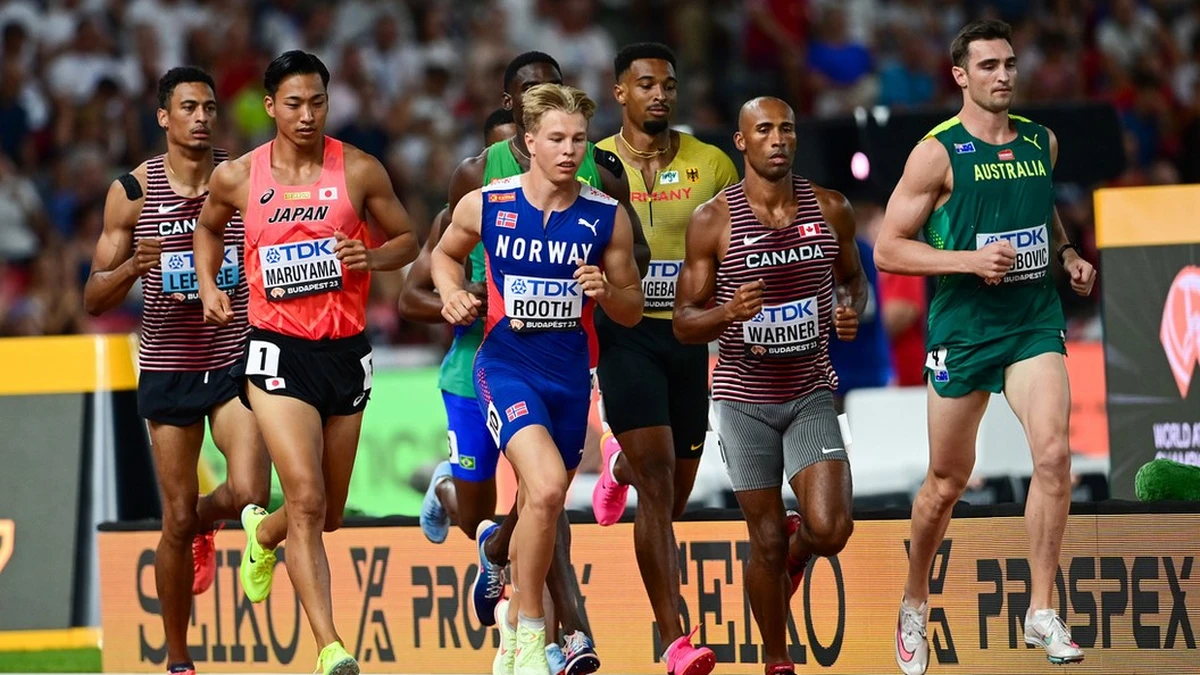
Nobody had Markus Rooth down as the favourite when the men’s decathlon began at the Paris 2024 Olympic Games on 2 August 2024. The field was stacked with men who had scored more, won more and been around longer, and after the first five events Rooth sat seventh, 4,459 points on the board — his best first-day score ever, but still well off the lead. What happened on day two is the reason his name now sits in the record books. He set personal bests in four of the five remaining events — the 110 metres hurdles, the discus, the pole vault and the javelin — and when he crossed the line in the closing 1500 metres, the total read 8,796 points: a new Norwegian record, and enough for gold.
The margin was 48 points. Germany’s Leo Neugebauer, the world leader going into Paris, took silver with 8,748, and Grenada’s Lindon Victor took bronze with 8,711, in a competition so deep that it was only the second time in Olympic history that all three medallists had passed 8,700 points — and the first decathlon ever in which ten men broke 8,400. Rooth was 22 years old when he won it, which made him the second-youngest Olympic decathlon champion in history, behind only Bob Mathias, who was 17 when he won in London in 1948, according to Canadian Running Magazine’s report on the upset. He was also the first Norwegian to win the event since Helge Løvland at Antwerp in 1920 — a gap of 104 years.
The most talked-about moment of those two days did not even involve Rooth directly. His Norwegian teammate Sander Skotheim, himself a medal contender, failed to clear a height in the pole vault and fell out of contention — then stayed in the competition anyway to pace Rooth through the 1500 metres, shouting him home in the final straight. Skotheim later received the World Athletics Fair Play Award for it, as Sportstar reported. It was a small act that said a lot about the Norwegian combined-events group: two men from the same small training environment, one of them putting the other’s race ahead of his own disappointment.
Ten events, one record series

A decathlon is not one race but ten, spread over two days, and the points table rewards the all-rounder rather than the specialist. Rooth’s Paris series shows why he won: there was no weak event left for his rivals to attack. He opened with 10.71 seconds in the 100 metres, then jumped 7.80 metres in the long jump, threw the shot 15.25 metres, cleared 1.99 metres in the high jump and ran 47.69 seconds for 400 metres to close day one. Day two brought 14.25 seconds in the 110 metres hurdles, a 49.80-metre discus throw, a 5.30-metre pole vault, a 66.87-metre javelin throw and a 4:39.56 1500 metres. Every one of those marks is listed on his World Athletics profile and Wikipedia record, and together they add up to 8,796.
Look closer and the shape of the performance becomes clear. His biggest single scores came from the long jump (1,010 points), the pole vault (1,004) and the hurdles (965) — three events that demand completely different bodies and skills, which is the whole point of the decathlon. The javelin gave him 842, and even his weakest score, the 1500 metres at 683 points, was run with a team-mate shouting splits at him and a gold medal on the line.
For scale: 8,796 is a Norwegian record by a distance, but Kevin Mayer’s world record of 9,126 points, set in 2018 remains a long way away. What Paris proved was narrower and more useful — that on the biggest stage, over two days, Rooth could produce ten solid marks without a disaster. In the decathlon, that is usually enough.
The road to Paris was not a straight line
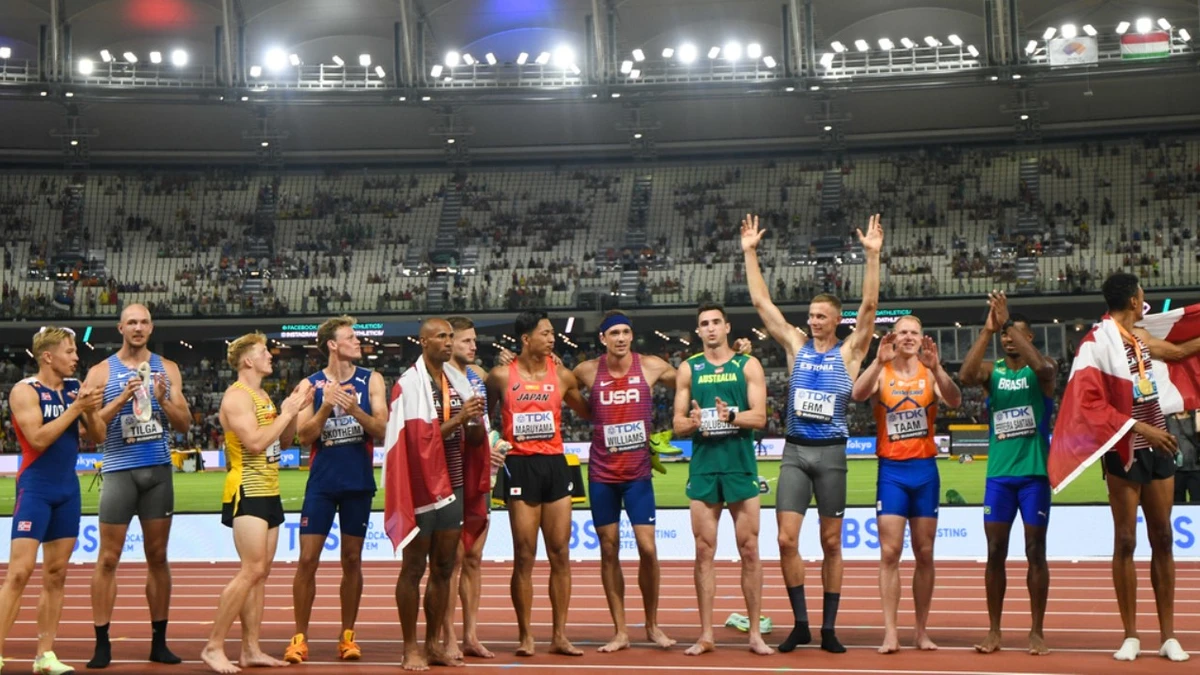
Rooth was born on 22 December 2001 in Oslo and competes for IK Tjalve, the Oslo club, and his rise through the age groups was fast but not flawless. He took bronze at the European Under-20 Championships in Borås in 2019 with 7,692 points, then set a Norwegian under-20 record of 8,238 points at Bislett in June 2020 — a score that put him second on the world under-20 all-time list, behind only Germany’s Niklas Kaul, as recorded in the championship results. Bronze followed at the European Under-23 Championships in Tallinn in 2021 with 7,967 points, another Norwegian age-group record.
The first senior Norwegian record came in May 2022, when he won the Multistars meeting in Grosseto with 8,307 points — nine points more than Skotheim’s record. Then came Espoo in July 2023, the competition that announced him properly: gold at the European Under-23 Championships with 8,608 points, a championship record and another Norwegian record, beating Skotheim by 47 points with six individual personal bests across the two days. His cousin Andrea Rooth won the women’s 400 metres hurdles gold at the same championships on the same day, a family double that European Athletics covered at the time.
What followed was a reminder that the decathlon punishes everyone eventually. At the World Championships in Budapest in August 2023 he finished eighth with 8,491 points — respectable, but not a medal — and at the World Indoor Championships in Glasgow in March 2024 he did not finish the heptathlon, pulling out before the final event. Then came Rome in June 2024, the senior European Championships, where he was in medal contention after day one — 4,456 points, including a long jump personal best of 8.01 metres — before an injury in the pole vault ended his competition. Johannes Erm of Estonia won that title with 8,764 points, Skotheim took silver, and Rooth went home with nothing. Two months later he was Olympic champion. The gap between those two results is the whole story of his career so far: the talent was never in doubt, but the decathlon only rewards it when all ten events hold together, and in Rome they did not.
What Olympic gold actually pays
Here is where honesty matters more than excitement. World Athletics, the sport’s governing body, paid US $50,000 to each individual athletics gold medallist at Paris 2024 — the first time any international federation had paid prize money at the Olympic Games — from a pot of $2.4 million spread across 48 events. Rooth, as decathlon champion, falls under that scheme, and World Athletics confirmed the payments before the Games. The International Olympic Committee itself pays no prize money to medallists. So the verified, attributable cash that came directly from winning in Paris is $50,000 — a serious sum for a 22-year-old, but not a fortune, and not the kind of money that explains a net worth figure on its own.
Beyond that, the honest answer is that there is nothing verified to add. No salary figure for Rooth has been published. No sponsorship contract value has been reported anywhere credible. He wears the Norwegian national-team kit, and in Paris that kit carried a Puma logo, while later social media posts have shown him in Nike kit — but kit branding at a championship is team branding, not evidence of a personal contract, and the two pictures conflict, so neither brand can be named here as his personal sponsor. No Norwegian tax-list income or wealth figure for him has been published either: the official tax-list search is run by the Norwegian Tax Administration, and searching it requires logging in — the Skatteetaten tax-list page states that plainly. No newspaper has published his figures from those lists. That absence is itself a fact worth stating, because it is the reason no number appears in this article. Anyone quoting a net worth for Markus Rooth in 2026 is guessing, and this article will not join them.
What can be said, carefully, is that an Olympic champion from Norway is in a strong position to earn more than before Paris — appearance fees, national-team support, commercial deals negotiated on the back of a gold medal. All plausible, none of it public, none of it numbered. The $50,000 from World Athletics is the only figure that can be written down with a source beside it.
The year after the gold
The months after Paris brought the kind of recognition that does not come with a price tag attached. At the Norwegian Sports Gala in Trondheim in January 2025, Rooth won three awards in one night: Male Athlete of the Year, Breakthrough Sportsperson of the Year, and Name of the Year, the last of them a public vote. For a decathlete — an athlete in a discipline that rarely makes the front pages — that was a measure of how far the gold had travelled beyond the stadium.
Then, in August 2025, the sport reminded him how quickly it can all stop. On 24 August, the day before he was due to fly to the World Championships in Tokyo, he was injured in a pole vault training accident, landing outside the mat and hurting his knee and elbow badly enough to need surgery. He announced on 25 August that he would miss Tokyo and face at least four months out, as NBC Sports reported. It was a cruel piece of timing: a year after the best weekend of his life, he was watching a World Championships from a hospital bed. Before the accident he had shown his form was still there, clearing a pole vault personal best of 5.33 metres at a street meet in Athens on 6 July 2025.
The comeback arrived in September 2026 at the Décastar meeting in Talence, France — his first decathlon since Paris, more than two years after the gold. He finished ninth with 8,209 points while Skotheim won with 8,630, and the result was reported by World Athletics as part of its combined-events tour coverage. Ninth place does not sound like much next to an Olympic title, but after surgery and a year away, finishing a full decathlon at all was the point. The score was nearly 600 points short of Paris, and nobody should pretend otherwise — but the ten events were completed, the body held, and the road back had a starting point.
The fair summary: Markus Rooth Net Worth 2026
Markus Rooth Net Worth 2026 is unconfirmed, and after everything above, that should not be a surprise. He is 24 years old, an Olympic champion with a Norwegian record of 8,796 points, a European under-23 champion, and a man who has already come back once from a serious injury. The one verified payment tied to his gold medal is the $50,000 World Athletics prize for Paris 2024. There is no published salary, no published sponsorship value, no published tax-list income or wealth figure, and no credible estimate to quote — so there is no net worth number in this article, only the facts that would have to support one if it ever appears. What is certain is the sporting position: an Olympic gold, a national record, and a career that, injury permitting, still has its best years in front of it.
Sources & References
- World Athletics — Paris 2024 Olympics report, men’s decathlon: https://worldathletics.org/competitions/olympic-games/the-xxxiii-olympic-games-7153115/news/article/paris-2024-olympics-report-men-decathlon
- World Athletics — Key information, athletics at the Paris 2024 Olympic Games (US $50,000 prize money for gold medallists): https://worldathletics.org/competitions/olympic-games/la28/news/article/key-information-athletics-paris-2024-olympic-games
- Wikipedia — Markus Rooth (biography, personal bests, competition record): https://en.wikipedia.org/wiki/Markus_Rooth
- Wikipedia — Athletics at the 2024 Summer Olympics, men’s decathlon: https://en.wikipedia.org/wiki/Athletics_at_the_2024_Summer_Olympics_%E2%80%93_Men%27s_decathlon
- Wikipedia — 2023 European Athletics U23 Championships, men’s decathlon: https://en.wikipedia.org/wiki/2023_European_Athletics_U23_Championships_%E2%80%93_Men%27s_decathlon
- Wikipedia — 2023 World Athletics Championships, men’s decathlon: https://en.wikipedia.org/wiki/2023_World_Athletics_Championships_%E2%80%93_Men%27s_decathlon
- Wikipedia — 2024 European Athletics Championships, men’s decathlon: https://en.wikipedia.org/wiki/2024_European_Athletics_Championships_%E2%80%93_Men%27s_decathlon
- Wikipedia — 2019 European Athletics U20 Championships: https://en.wikipedia.org/wiki/2019_European_Athletics_U20_Championships
- Canadian Running Magazine — Norway’s Markus Rooth pulls off upset for gold in men’s decathlon: https://runningmagazine.ca/sections/runs-races/norways-markus-rooth-pulls-off-upset-for-gold-in-mens-decathlon/
- Sportstar (The Hindu) — Sander Skotheim wins International Fair Play Award: https://sportstar.thehindu.com/athletics/sander-skotheim-norway-wins-international-fair-play-award-athletics-paris-olympics-helped-marcus-rooth-gold-medal/article68956375.ece
- NBC Sports — Markus Rooth ruled out of Tokyo World Championships by injury: https://www.nbcsports.com/olympics/news/markus-rooth-decathlon-injury
- Sportstar (The Hindu) — Markus Rooth injury, ruled out of Tokyo World Championships: https://sportstar.thehindu.com/athletics/markus-rooth-injury-ruled-out-tokyo-world-championships-training-accident-olympic-decathlon-champion/article69977951.ece
- World Athletics — Talence Décastar 2026 report: https://worldathletics.org/competitions/world-athletics-combined-events-tour/news/talence-decastar-2026-thiam-warner
- Skatteetaten (Norwegian Tax Administration) — Search the tax lists: https://www.skatteetaten.no/en/forms/search-the-tax-lists/