
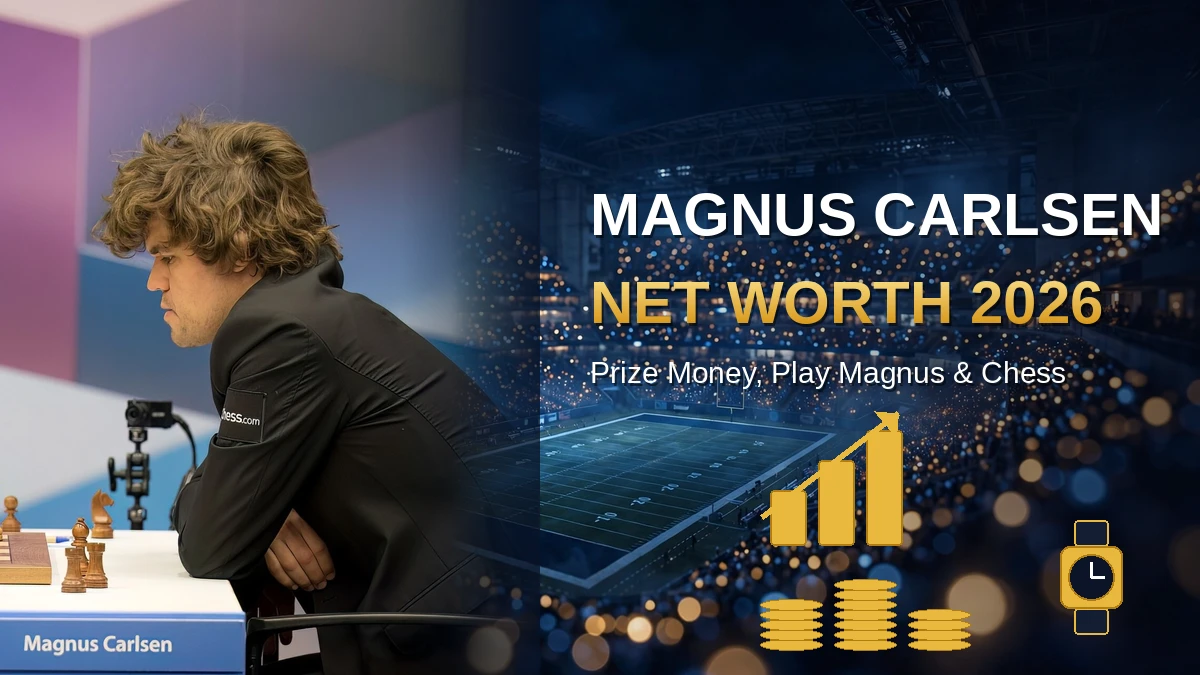

In 2020, Forbes reported that Magnus Carlsen had put about $13,000 into a chess start-up in exchange for a 60% stake. By December 2022 that company, Play Magnus Group, had been sold to Chess.com in a deal worth roughly NOK 800 million.
Carlsen did not pocket that figure. His holding had been diluted by then, and the sale price belongs to all shareholders. That gap between a headline number and what a person actually keeps is the story of his finances — and it repeats at every level, from a $13,000 seed investment to a career’s worth of prize money.
The $800 million sale that wasn’t his
Play Magnus was founded in 2013 by Carlsen, Espen Agdestein and Anders Brandt, built around an app that let anyone play against a chess engine trained on Carlsen’s own games at different ages. It was a clever idea with an obvious face, and it grew into something bigger: a group of chess businesses, a listing on Oslo’s Merkur Market, and eventually a takeover target.
It listed in October 2020, raising US$30.2 million in new equity, with a listing valuation of about US$120 million. Forbes valued his post-listing holding at about US$12 million. Wikipedia’s company page puts his family company, Magnus Chess, at 9.5% after the listing.
Chess.com’s offer came in August 2022. SportBusiness put the value at US$82 million, or NOK 798,885,386. The deal closed on 16 December 2022.

Here is where the arithmetic gets tempting — and where it has to stop. His exact stake at the sale could not be confirmed. As an illustration only, 9.5% of NOK 798.9 million is roughly NOK 76 million before tax. That is arithmetic, not a reported payout. The 9.5% figure is the post-listing holding, and two years of further share issues and dilution passed between the listing and the sale. The exact stake at the December 2022 close is unconfirmed in every public source we could find, and it is the one number that could materially change this story if it were ever disclosed. Until then, the honest statement is that Carlsen owned a founder’s stake in a company sold for roughly NOK 800 million, and his personal share of that is not publicly known.
What is known is that the sale ended one chapter and opened another. Carlsen went from being a chess player with a start-up to a chess player with a substantial, if undisclosed, capital gain — and with the freedom to pick his next projects rather than chase prize money alone. That freedom shows up in everything he has done since, from launching a new chess format to founding another start-up.
What the prize money actually adds up to
If the company story is about a number nobody can confirm, the prize-money story is the opposite: a number tracked to the dollar, that still does not mean what people think it means.
Chess.com’s tracker puts Carlsen’s career tournament prize money at US$12,232,249 through 31 December 2025, as cited by The Chess World. In 2025 he earned US$1,455,276, the highest of any player, per Chess.com’s annual recap. That tally excludes appearance fees, streaming, coaching and sponsorships — which means it understates his income, even as it overstates his wealth. Gross prize money is not wealth. Tax, travel and team costs come out first, and a chess career at the top level is not cheap to run.
His 2026 results add to the tally, and they also show how his career has changed shape. At the Freestyle Chess World Championship in Germany in February, he beat Fabiano Caruana 2½–1½ in the final of an event with a US$300,000 prize fund and US$100,000 first prize. It was his 21st world title, in a format he helped create. At the Esports World Cup in Paris in August, he won again, going unbeaten, for a US$250,000 first prize — a back-to-back win, all five matches without losing a single game, against Esipenko, Niemann, Sarin, Firouzja and Lazavik. And on the Champions Chess Tour 2025–26, he finished first overall and earned US$153,713.40 from the tour, the most of any player.

Three different kinds of chess, three different paydays, and none of them is the classical world championship he walked away from in 2023. That is the point. Carlsen no longer needs the classical title to earn, and he no longer wants the grind that comes with defending it. The money now follows him to the formats he chooses — freestyle, esports, online tour play — rather than the other way round.
The family company in the filings
Older Norwegian reporting is the closest thing to hard data on Carlsen’s business affairs, and it comes from a family company rather than from Carlsen himself. In 2016, DN reported MagnusChess AS revenue of NOK 13.4 million in 2015, down from NOK 17.1 million. Net profit was NOK 7.2 million, 85% to Carlsen and 15% to his father Henrik.
That year the company paid an extraordinary dividend of NOK 15 million and held NOK 19.7 million in equity. Company revenue and equity are not his personal wealth. They show how the business was run, not what he owned himself. An earlier DN report from 2013 gave MagnusChess revenue of about NOK 27 million since 2007.
These are old numbers now, from a decade ago, and that is itself informative. The public trail of Carlsen’s finances effectively goes quiet after the mid-2010s, except for the Play Magnus listing and sale, which are public because the company was listed. A private individual with private companies does not have to publish his balance sheet, and Carlsen does not. Anyone claiming to know his net worth to the nearest million is either guessing or pretending.
The $25–60 million argument
Carlsen’s net worth is not publicly confirmed. The estimates traceable to named websites range from roughly US$25 million to US$60 million. None cites any tax record, company filing or interview.
The range itself is the argument. Hello Swanky puts it at $60 million, in a piece dated 1 June 2026. chess.game says about $50 million, within a range of $25–60 million, updated 8 June 2026. The Chess World says about $25 million, attributed to unnamed reports, in its October 2026 update.

The gap comes from method. Each site guesses the value of his company shares, sponsorships and savings, without showing its working. What has changed since the live article is that the lower end has gained a fresher backer: The Chess World’s October 2026 update uses $25 million, and People.com put the same figure in February 2026. One specialist site, goldbuzz.co.uk, summarised the position as “the most credible and consistent valuations cluster around the $25 million mark”, with higher figures “inherently more speculative”. We read the documented pieces as fitting the lower and middle of the US$25–60 million range better than the top. That is a judgment, not a measurement.
Some sites go much further, claiming $70 million, $100 million or even $1.5 billion. We found credible sourcing for none of them. Forbes’ own Carlsen profile, last updated in March 2020, gives no net worth. Nor did any search turn up a Kapital wealth figure or a Norwegian tax-list number for Carlsen. The absence of a Forbes or Kapital figure is not proof that he is worth less than the estimates say. It is proof that nobody with access to primary records has published one, which is a different and more useful fact.
The building blocks we can document are these: prize money of about US$12.2 million in tracked career winnings, gross; a founder’s stake that was later diluted and then sold as part of an NOK 800 million deal; a family company with audited Norwegian figures from the 2010s; and a reported NOK 19.5 million house in Oslo’s Holmenkollen area. Everything else — the value of his current start-ups, his savings, his investments — is unreported. A reader who adds the prize money to a guessed share of the Play Magnus sale and calls the total a net worth has done two sums and made three assumptions.
Sponsors, start-ups and the next board
In September 2021, Mastercard named Carlsen a global brand ambassador and sponsored the Meltwater Champions Chess Tour. No financial terms were disclosed. One site puts sponsorship income at about US$2 million a year, but it names no source. We treat that as unverified.
The more interesting money story is what Carlsen has built rather than what he has endorsed. Carlsen and Jan Henric Buettner launched the Freestyle Chess Grand Slam Tour in 2025. Carlsen won it. No ownership stake is documented. In June 2024, Forbes reported his Oslo-based Fantasy Chess start-up had raised US$3 million in pre-seed funding, led by SNÖ Ventures and Coatue. Carlsen is a founder, but his equity is not disclosed.
There is a pattern here that the net-worth sites miss entirely. Carlsen’s second career is not a portfolio of endorsements; it is a series of bets on chess itself — on new formats, new audiences and new ways of selling the game. The Play Magnus sale proved that a chess business built around his name could be worth hundreds of millions of kroner. The question now is whether he can do it again with freestyle chess and fantasy chess, and whether the value of those bets will ever become public.
The champion’s record, and the life around it
Carlsen was born in Tønsberg and became a grandmaster in 2004, a few months after turning 13. He took the world title in 2013, and DN reported before that match that a win would bring a NOK 9 million prize. His rating peaked at 2882 in May 2014, the highest in history, and he has held the world No. 1 ranking since 1 July 2011. In 2023 he gave up defending his classical title, citing a lack of motivation. He remains world champion in rapid, blitz and now Freestyle formats, per Wikipedia. His FIDE rating stood at 2823, world No. 1, in September 2026.
He bought a house in Holmenkollen for a reported NOK 19.5 million in 2015, according to VG as relayed by DN. He owned it privately, not through his company. He married Ella Victoria Malone in 2025. We found no other verified lifestyle spending, and there is something fitting about that: the most famous chess player alive is also one of the least conspicuous rich men in Norway, a person whose public spending seems to extend to a house and very little else.
Where that leaves it: Magnus Carlsen net worth 2026
Carlsen’s chess record is easy to verify. His wealth is not. The best-documented pieces are tracked prize money of about US$12.2 million, a start-up stake in an NOK 800 million sale, and a family company that paid NOK 15 million in dividends in 2015. Online estimates of US$25–60 million are plausible, but no one has shown the working — and the freshest 2026 sources point to the bottom of that range, where the documented pieces also sit.
Treat any precise figure, and any billion claim, with suspicion. The man who put $13,000 into a chess start-up and watched it sell for NOK 800 million understands the difference between a headline number and what someone actually keeps better than anyone. His own finances are the proof.
Related reading: our net-worth profiles of more Norwegian sports stars – Casper Ruud, Viktor Hovland and Martin Ødegaard.
Sources & References
- Magnus Carlsen, Wikipedia: biography, titles, ratings, 2025–26 results
- FIDE Freestyle Chess World Championship 2026, Wikipedia: dates, prize fund, final result
- Freestyle Chess, Wikipedia: Grand Slam Tour organisers
- Champions Chess Tour 2025–26, Wikipedia: tour prize totals
- Play Magnus Group, Wikipedia: listing, Chess.com acquisition, Magnus Chess 9.5% holding
- Chess.com: Top chess prizewinners in 2025: 2025 prize money
- Chess.com: 2026 Esports World Cup, 7 conclusions: Paris result and first prize
- The Chess World: richest chess players: career prize total, $25 million estimate
- Hello Swanky: Magnus Carlsen net worth: $60 million estimate
- chess.game: Magnus Carlsen net worth: about $50 million estimate
- Forbes: Play Magnus listing: stake, raise, valuation
- Forbes: Mastercard signs Carlsen: ambassador deal
- Forbes: Fantasy Chess raises $3 million: start-up funding
- Forbes: Magnus Carlsen profile: no net worth listed
- SportBusiness: Chess.com to acquire Play Magnus Group: deal value
- DN (2016): Magnus Carlsen tok ut 15 mill. ifjor: MagnusChess AS figures, house
- DN (2013): Millionene renner inn for sjakk-esset: early revenue, title prize
- People.com: Magnus Carlsen net worth (February 2026): $25 million estimate




[…] reading: our net-worth profiles of more Norwegian sports stars – Magnus Carlsen, Viktor Hovland and Martin […]
[…] reading: our net-worth profiles of more Norwegian sports stars – Casper Ruud, Magnus Carlsen and Aksel Lund […]
[…] Related reading: our net-worth profiles of more Norwegian sports stars – Erling Haaland, Alexander Sørloth and Magnus Carlsen. […]