


For twenty-eight years, Bjørn Dæhlie held a record no Winter Olympian had touched: eight gold medals. Then, in February 2026, Johannes Høsflot Klæbo won his ninth, and the record moved on. Dæhlie had stopped being measured in medals long before that — he retired in 2001, and the second half of his public life has been quieter and far more interesting in money terms than the first.
This article is about the business he built after the skiing, and the honest difficulty of saying what he is worth now. There is no verified 2026 net worth figure for Bjørn Dæhlie — only a rich-list estimate from 2023, company accounts from 2025, and a tax-list number he has publicly called wrong. They point roughly the same way, around NOK 800 million, and they still measure different things.
The number everyone quotes is three years old
The best-sourced estimate of Dæhlie’s personal wealth comes from Kapital, the Norwegian business magazine behind the country’s most-watched rich list. Its list of Norway’s 400 richest put Dæhlie at NOK 800 million in September 2023, according to Klar Tale — the third-richest Norwegian athlete on it, behind Erling Haaland at NOK 1.8 billion and Bjørn Maaseide at NOK 1 billion.
At the exchange rate of 16 September 2026, about 9.35 kroner to the dollar, NOK 800 million is roughly USD 86 million. It is a large sum, and it is also, by now, an old one: Kapital publishes its list each autumn, and no 2024, 2025 or 2026 Kapital figure for Dæhlie has surfaced publicly. The figure should always carry its date — Kapital’s September 2023 estimate, not his current net worth.
That ranking has already moved on: Haaland’s estimate has since risen to NOK 4.3 billion, per E24’s September 2026 coverage.
Three figures that look alike and aren’t
Here is where most net-worth writing goes wrong: three numbers circulate for Dæhlie, all in the same rough range, and they get added together or swapped around as if they were the same thing. They are not.
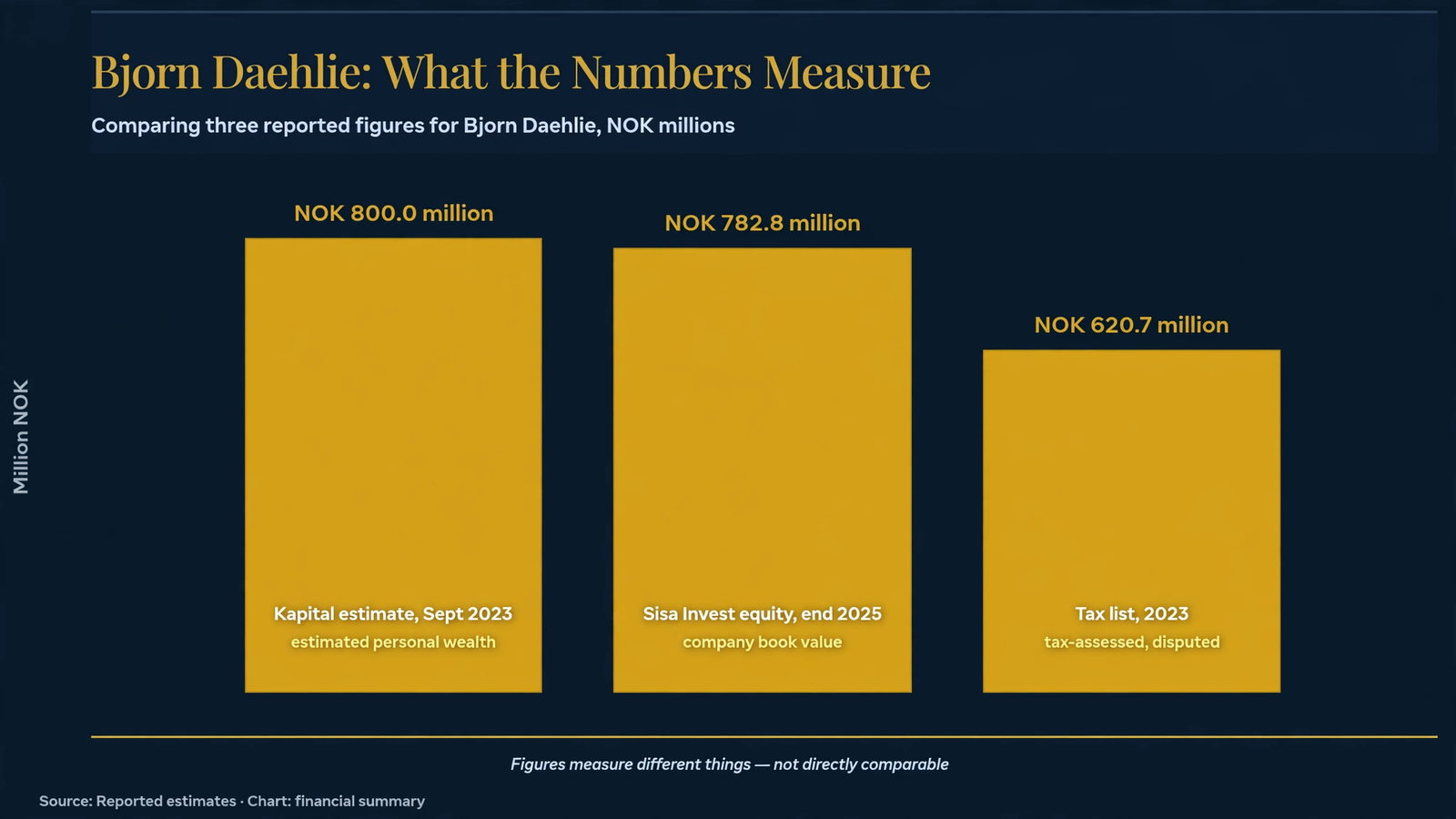
The first is the Kapital estimate: NOK 800 million, September 2023. The second is the equity of his investment company, Sisa Invest: NOK 782.8 million at the end of 2025, according to the company’s 2025 accounts. The third is a tax-list figure for 2023: NOK 620.7 million, which Dæhlie has disputed.
That the first two land within a few percent of each other tempts a neat reading — that Sisa Invest holds most of his wealth, so the two numbers confirm each other. The sources do not say that. Equity is a company’s book value, assets minus debts as recorded in the accounts: not market value, and leaving out anything he owns outside the company.
The tax-list figure needs even more care. Tax-assessed wealth is a narrow snapshot: some assets are valued below market price, debts are deducted, and what sits in a company or abroad may not show up at all. A gap between it and a rich-list estimate proves nothing on its own. In Dæhlie’s case there is a specific reason to be cautious, and it has to do with where he lives.
A company that rises and falls with the markets
Sisa Invest is Dæhlie’s wholly owned investment company, and its accounts are the most concrete public window into his finances. They also show how little his wealth resembles a salary: in a good year the company makes a fortune, in a bad year far less, and the equity still creeps upward.
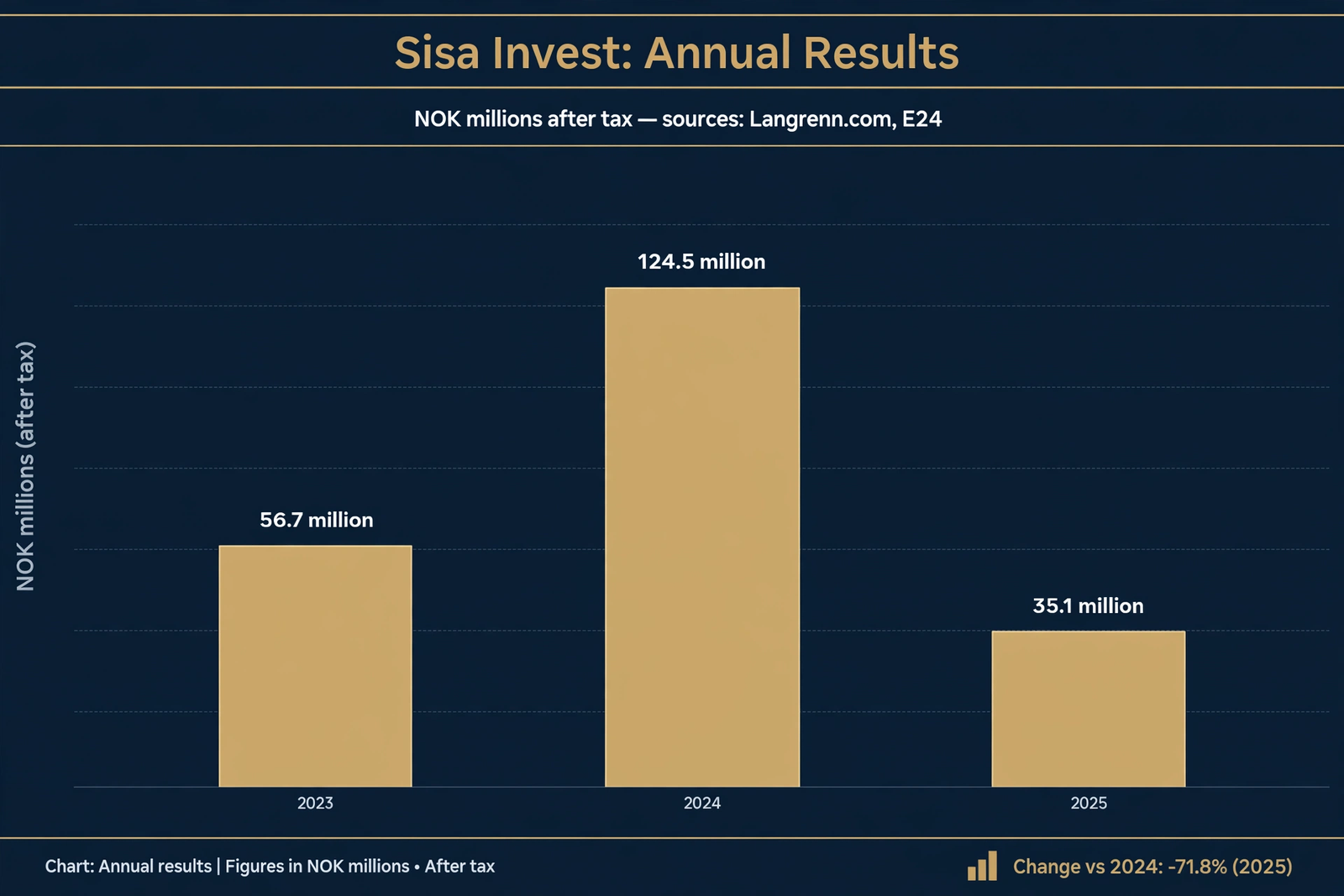
The recent run tells that story plainly: an annual result after tax of NOK 56.7 million in 2023, then NOK 124.5 million in 2024, and then NOK 35.1 million in 2025, a fall of nearly three quarters. The 2023 and 2024 figures come from Langrenn.com, which reported that the 2024 jump came mainly from financial income, rising from NOK 92.2 million to NOK 177.6 million. The 2025 figures come from the company’s own 2025 accounts, where financial income fell by about NOK 110 million, to NOK 66.9 million.
Yet equity kept growing, from NOK 751.7 million to NOK 782.8 million in 2025. A single year’s profit is a flow, driven by markets; equity is the stock built up over decades, and one weak year barely dents it. Dividends were modest — NOK 10 million in 2024, against NOK 16 million the year before. The money, by and large, stays in the company.
None of this is personal income. A NOK 124.5 million company result does not mean Dæhlie earned that much that year; it is what his company made after tax, before any decision about dividends, and it says nothing about what he took out or spent.
Look back a decade: DN reported in September 2015 that Sisa Invest held equity of about NOK 283 million, adding that, because much of the value sat in property, the adjusted equity could be higher. From roughly NOK 283 million then to NOK 782.8 million at the end of 2025 is a near-tripling in ten years.
What the company actually owns
The 2015 DN report gives the clearest public inventory of what sits inside Sisa Invest: Eidsvoll Jernbanehotell, Eidsvoll Stasjon, the Dæhlie cabins and the Swedish company Dæhlie Stugan AB, plus shares and stakes worth about NOK 149 million at the time. Its profit in 2014 was NOK 39.3 million after tax.
That mix is a property-heavy investment company with a share portfolio on the side, and its results swing with financial income because the share portfolio does. When markets are kind, the company posts a year like 2024; when they are not, a year like 2025. The property underneath moves far more slowly, which is why equity is steadier than profit.
The 2015 snapshot is ten years old, and no equally detailed public breakdown has appeared since. We know the total has grown; we do not know, property by property, what drove it — normal for a private investment company.
The boy from Elverum who wanted to play football
Dæhlie was born on 19 June 1967 in Elverum, Norway, and is 59. He grew up hunting, fishing, kayaking and playing football, and wanted to be a footballer until a coach pushed him toward Nordic skiing, according to Wikipedia. He had little junior success and kept improving — slowly, then all at once.
He was no prodigy — a fit, stubborn young man from a small town who found the sport that suited him late and refused to give it up. The money came later still, from business after the skiing stopped, not from the skiing itself.
Nine winters that made him famous
Between 1991 and 1999, Dæhlie collected 29 Olympic and World Championship medals: 12 at the Olympics — eight gold, four silver — across Albertville 1992, Lillehammer 1994 and Nagano 1998, and 17 at the World Championships — nine gold, five silver, three bronze. On the World Cup circuit he took 46 individual wins and six overall titles, and was Norwegian Sportsperson of the Year in 1995 and 1998.
Then, in August 1999, a roller-ski accident left him with a back injury, and after rehabilitation and surgery attempts he retired in March 2001 — 33, at the top of his sport, and finished.
What he earned in prize money and sponsorship during those racing years is not documented in the sources behind this article, and no estimate is offered here. What is documented is what he built afterward, and that is where the wealth sits.
The sale that started the second fortune
The first clear business milestone came a decade after retirement. DN reported that Dæhlie sold Bj Sport AS, the company behind his clothing line, to Active Brands for about NOK 70 million in February 2011 — the third time he had sold the company, according to the headline. He built the brand, sold it, bought it back, built it again, and sold it again.
NOK 70 million is a fraction of the NOK 782.8 million his investment company is worth on paper today, but it is the seed the rest grew from. The skiing made him famous; the sale made him an investor.
Switzerland, and why a tax number is argued about
Dæhlie lives in Switzerland. He moved there in February 2022, settling first in Zug and then in Nidwalden in 2023, according to Wikipedia, citing his confirmation to Nettavisen. That move is the key to the disputed tax-list figure — it should never be quoted without the dispute attached.
In December 2024, Finansavisen reported that the Norwegian tax lists showed NOK 620.7 million for 2023. Dæhlie told the newspaper the figure was wrong and blamed slow processing at the tax authority: “My assessment for 2023 has been corrected, it was wrong” (translated from Norwegian). A 2023 Norwegian tax-list figure for a man Swiss-resident since February 2022 is, at best, a record of residual Norwegian-registered assets or of timing — not a measure of his personal wealth. That is plausibly why the number was contested, and why this article keeps the “disputed” label on it.
The tax lists have followed him for years: Skatteetaten data cited by Innomag listed him at NOK 225 million in a February 2014 article on Olympic stars, ahead of every other athlete in the table. That was a different era — before the move, before the equity nearly tripled.
A house in Sweden he doesn’t live in
In 2021, Dæhlie bought a plot in the Strömstad area of Sweden, and a new house was completed in summer 2025, which he calls a leisure property. He still lives in Switzerland.
Beyond that, verified details about his homes, cars and spending are thin. He has also supported multiple sclerosis causes, including racing the American Birkebeiner in 2009 as a fundraiser, according to Wikipedia. That is the public record on his life outside business: a house in Sweden he visits, a home in Switzerland he lives in, and a charity race from more than fifteen years ago.
What could move the number
Sisa Invest’s results show how exposed his wealth is to markets: a NOK 89 million drop in profit in one year, with equity still rising. Kapital updates its list each September, and its next edition would show whether the NOK 800 million estimate has moved — though a new Kapital figure for Dæhlie is not guaranteed to appear.
The best-sourced estimates cluster around NOK 800 million, the company accounts put book equity a little below that, and a disputed tax-list figure sits lower still. They measure different things, they come from different years, and nobody outside his circle can say what he is worth today. The wealth was not made by medals, but after he retired — a clothing business sold three times over, and a property-heavy investment company grown quietly to nearly NOK 800 million in book equity.
This article reflects information available on 12 October 2026. Net worth figures are estimates and are not confirmed by Bjørn Dæhlie or his representatives.
Related reading: our net-worth profiles of more Norwegian sports stars – Bjørn Maaseide, Aksel Lund Svindal and Erling Haaland.
Sources & References
- E24: Kraftig resultatfall for Dæhlie-selskap (Sisa Invest 2025 result and equity, reported 4 August 2026)
- Klar Tale: Dette er de rikeste idrettsutøverne (Kapital’s NOK 800 million estimate, 21 September 2023)
- Langrenn.com: Dæhlie doblet inntektene i 2024 (2023–24 results, Sweden property, 5 August 2025)
- DN: Dæhlie god for 283 mill. (Sisa Invest holdings, September 2015)
- DN: Dæhlie selger selskapet for tredje gang (Bj Sport AS sale, February 2011)
- Finansavisen: Dette er de rikeste Sveits-flyktningene (tax-list wealth and Dæhlie’s response, December 2024)
- Innomag: Norges rikeste OL-stjerner (Skatteetaten figures, February 2014)
- Wikipedia: Bjørn Dæhlie (biography, medals, retirement, Switzerland move)
- E24: Kapital: 4,3 milliarder i formue (Haaland comparison, September 2026)
- Flashscore: Klæbo claims record ninth gold (Olympic record, February 2026; headline and summary only)
- Pound Sterling Live: USD to NOK 2026 (exchange rate)




[…] reading: our net-worth profiles of more Norwegian sports stars – Bjørn Dæhlie, Bjørn Maaseide and Viktor […]
[…] reading: our net-worth profiles of more Norwegian sports stars – Bjørn Dæhlie, Aksel Lund Svindal and Alexander […]
[…] reading: our net-worth profiles of more Norwegian winter sports stars – Aksel Lund Svindal, Bjørn Dæhlie and Martin […]