
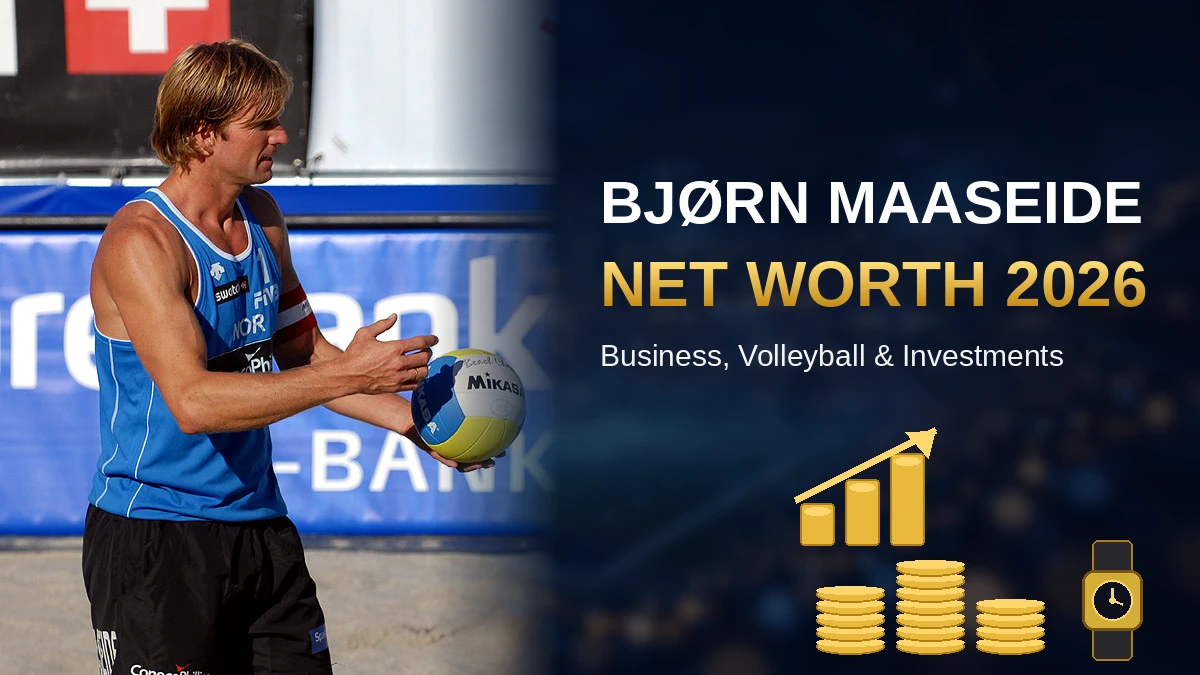

Bjørn Maaseide went to three Olympic Games and never won an Olympic medal. Seventh in Atlanta, seventeenth in Sydney, seventeenth again in Athens. By the usual maths of sport, that is a respectable career and not a rich one.
Then, in September 2023, Kapital put his fortune at NOK 1 billion and ranked him Norway’s second-richest athlete, behind only Erling Haaland. A beach volleyball player who never stood on an Olympic podium was, on paper, worth more than almost every other sports star in the country.
That contradiction is the whole story. Maaseide did not get rich from volleyball. He got rich from gyms, and later from banking — and he started building the business while he was still playing. The best number anyone has is three years old, and he has never published his finances.
The billion-kroner estimate, and its age
Kapital publishes its list of Norway’s 400 richest people every autumn, and in September 2023 it placed Maaseide at an estimated NOK 1 billion. Klar Tale’s report on the list put him second among athletes: Haaland at NOK 1.8 billion, cross-country skier Bjørn Dæhlie at NOK 800 million. Other Norwegian outlets have since called him the country’s richest former athlete, and DN’s topic page on him carries headlines that use the word “billionaire” without hesitation.
That word needs a caution, because “billionaire” means two different things depending on the currency. NOK 1 billion is about USD 107 million at the 16 September 2026 rate of 9.35 kroner to the dollar. In kroner he clears the billion mark; in dollars he is a long way from it. Norwegian headlines count in kroner.
The number also has an age problem. Kapital updates its list every year, and no 2024, 2025 or 2026 figure for Maaseide has surfaced publicly; Kapital’s own pages block automated access, so the 2023 estimate is the latest that can be checked. Three years is a long time for a fortune built on shares. NOK 1 billion is the best-sourced number there is — and a snapshot from another year, which is how it should be read.
What can actually be counted
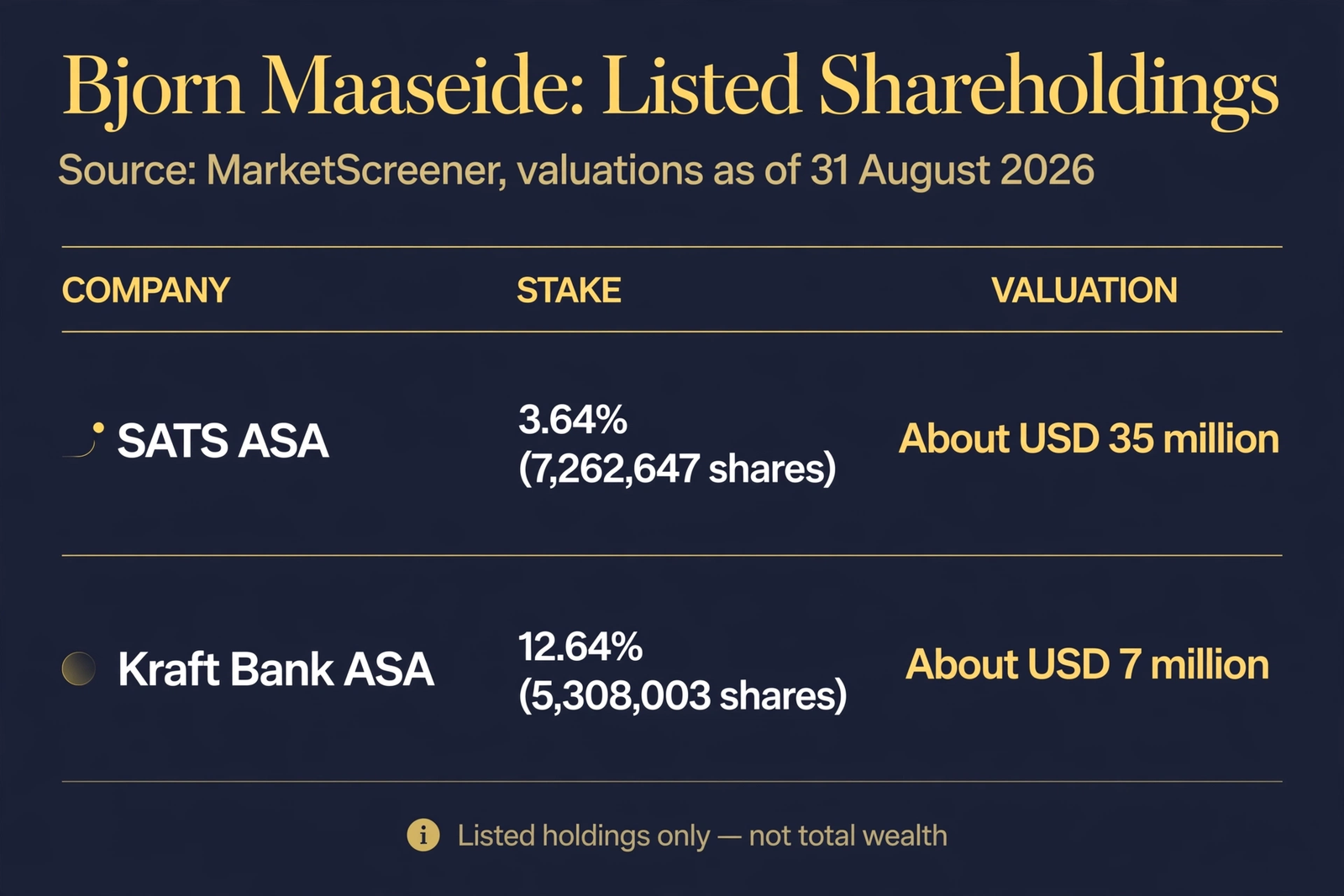
If the Kapital estimate is the headline, the company records are the fine print: smaller, drier, and much harder to argue with. Market data site MarketScreener lists his stakes in two listed companies, valued as of 31 August 2026: 3.64% of SATS ASA (7,262,647 shares, about USD 35 million) and 12.64% of Kraft Bank ASA (5,308,003 shares, about USD 7 million).
Together that is about USD 42 million, roughly NOK 390 million at the September rate. That is a floor, not a total: two listed holdings, nothing about private companies, property, cash or debts, and share prices that move daily. Still, it is a number tied to named shares on a named date, which anyone can check.
It also puts the Kapital figure in perspective. If the listed stakes are worth around NOK 390 million, roughly NOK 600 million of the 2023 estimate sits elsewhere — private holdings, property, cash, or Kapital’s own assumptions about values no public register shows. That is not proof the estimate is wrong, but it shows how much of the number rests on things the public cannot see.
Why the tax lists swing by hundreds of millions
Norway publishes annual tax lists, and local papers love checking what famous residents reported. For Maaseide, those lists are a warning about what tax figures can and cannot tell you.
In 2013, Aftenbladet reported tax-assessed wealth of NOK 319 million. Two years later, in the 2015 lists, the figure was zero. Aftenposten reported NOK 378.4 million in wealth and NOK 13.7 million in income for 2017 — then NOK 28.6 million in the 2018 lists, a fall of about NOK 350 million in a single year. Maaseide told Dagbladet it was “just some structural changes” in how his companies were owned.
He was, by his own account, describing paperwork rather than a real loss, and the pattern backs him up. Tax-assessed wealth depends on how assets are held and how the tax rules value them. Move a holding from one company to another and the number on the list can collapse or soar while nothing has actually been bought or sold.
So this article treats the tax lists as colour, not evidence. They show his wealth has always been tied up in companies rather than a salary. Quoting one year’s tax-list wealth as his net worth is a basic error.
The gym chain that made him
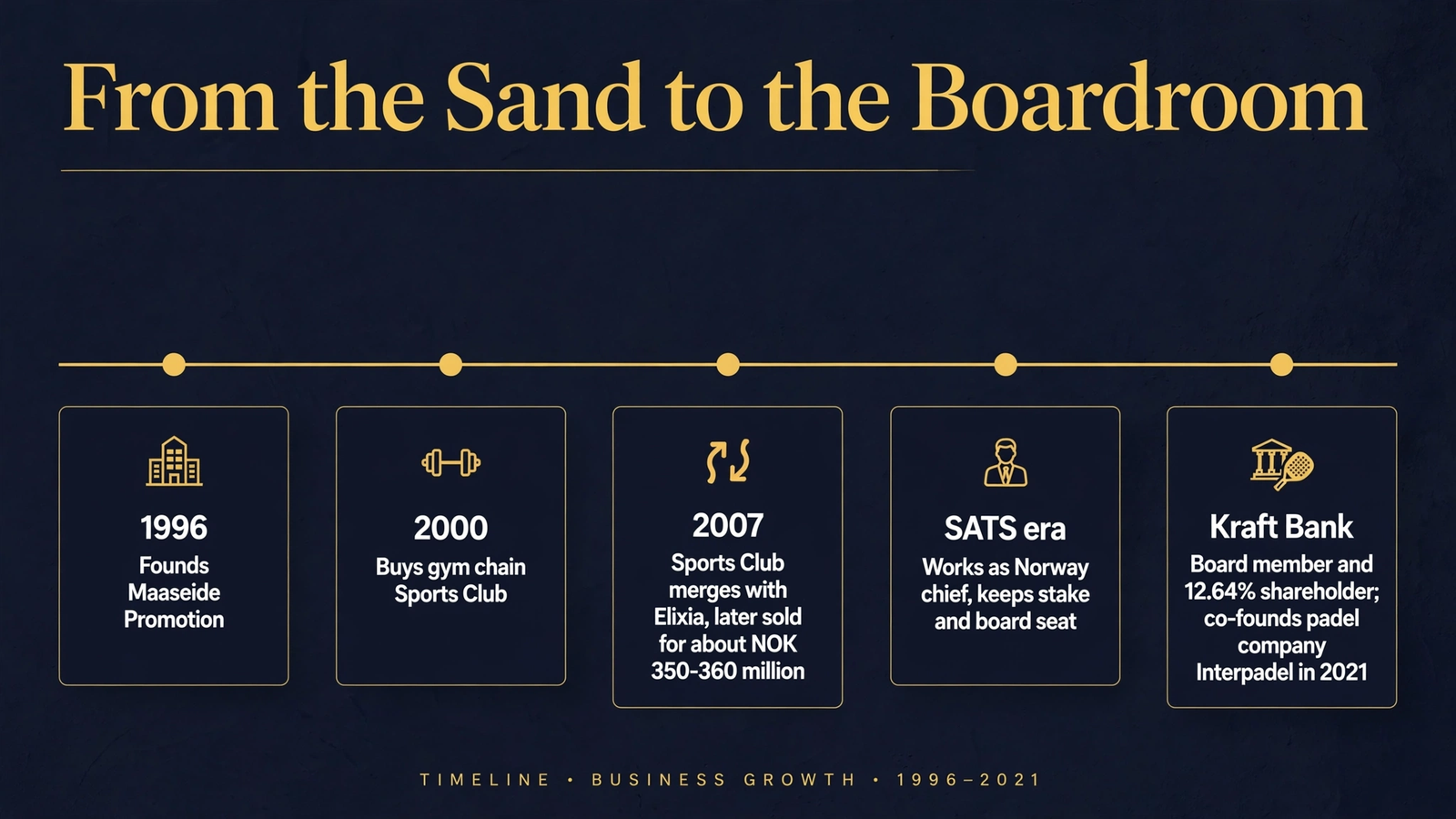
The money starts with a decision made years before it paid off. Maaseide began building his business while he was still competing — not a retired player looking for something to do, but an active Olympian buying companies between tournaments. In 1996, the year of his first Olympics, he founded Maaseide Promotion, which promoted volleyball matches, including his own.
The big step came in 2000, when he bought the gym chain Sports Club. Seven years later Sports Club merged with Elixia, and Elixia was then sold to the buyout fund Altor. Store norske leksikon says he earned roughly NOK 350 million from the sale; DN puts it at about NOK 360 million over two sales. The sources disagree, so “about NOK 350–360 million” is the honest way to state it. Either way, it was the single transaction that turned a volleyball player into a wealthy man.
Elixia later merged with SATS, the Nordic gym giant, and Maaseide stayed close to the business he had helped build. He worked as SATS’s Norway chief for about two years, and still holds a stake and a board seat, according to MarketScreener.
What volleyball itself paid him is not documented — earnings from the sport, endorsements and prize money do not appear in the sources available, so this article does not estimate them. Beach volleyball in the 1990s paid nothing like football or golf; the money came later, from the businesses.
The bank, and the second act
If the gym story is about timing — buying a chain before fitness became big business in Norway — the banking story is about nerve. DN reported that the former volleyball star was starting a bank, and MarketScreener now lists him as a board member and 12.64% shareholder of Kraft Bank ASA. A stake of that size is not a passive investment. It is a position with influence, and a board seat to match.
Kraft Bank is a small bank by Norwegian standards, and the 12.64% stake, worth about USD 7 million, is the smaller of his two listed holdings. But it shows where his attention went after the gyms: into financial services, where his capital and contacts could work together. DN headlines have also noted that Kraft Finans, a related company, received criticism from Finanstilsynet, the regulator, in a report — though the page shows no date, and the connection to his stake has not been verified.
The other venture worth a line is padel. In 2021 he co-founded Interpadel with cyclist Thor Hushovd and his old partner Jan Kvalheim. No figures have been published.
Three Olympics, one European title
None of this makes sense without the sporting career that came first, so here it is, briefly. Maaseide was born on 7 March 1968 in Stavanger, and he is 58. He stands 198 cm tall. His sport started indoors: according to Store norske leksikon, he debuted for Hana VBK’s senior team in 1983, played professionally for Nice in France in 1988–89, then took a US scholarship to UCLA. He earned his only indoor caps for Norway starting in 1992. His sister, Kathrine Maaseide, is also a professional beach volleyball player.
From 1991 he teamed up with Jan Kvalheim, and the pair became one of Europe’s best: European champions in 1994, silver in 1993, 1997 and 1998, bronze in 1999, gold at the 1994 Goodwill Games, and winners of the 1994–95 FIVB world series, according to SNL.
He played at the Olympics in 1996, 2000 and 2004, finishing seventh in Atlanta and seventeenth in both Sydney and Athens. He returned to competition in 2007, did not qualify for Beijing 2008, and retired in 2009 at 41. His commitment also helped bring the 2009 Beach Volleyball World Championships to Stavanger, a fitting send-off in his home city.
He was a very good European player in a sport that, in Norway at least, stayed small — no Olympic medal, no world title, no endorsement fortune. His wealth is not a reward for sporting greatness. It is a reward for what he did with the years around the sport.
The part that stays private
Verified details about how Maaseide lives are scarce, and the few that exist are old. In 2013, DN reported that he paid NOK 19.5 million for a 1910 villa near Vågen in Stavanger and spent about NOK 12 million on renovation — a record price for the city at the time. Whether he still owns it has not been confirmed.

In autumn 2023 he moved to Switzerland, according to SNL. Finansavisen carried a story on the move, and DN has run commentary on Norway’s exit tax in connection with it. What the move shows is the practical side of a fortune built on shares: once the wealth exists, where you live becomes a financial decision as much as a personal one.
That privacy is part of why the estimates vary. Maaseide has never published his finances, and the public record is a patchwork of old tax lists, two listed shareholdings and a three-year-old magazine estimate.
What could change the picture
A large part of his value likely sits in shares, so SATS and Kraft Bank prices matter more than any list. A strong year for either lifts the visible part of his wealth; a bad year cuts it. The next list, due around September 2027, will show whether the 2023 estimate still looks fair or whether three years of market movement have left it behind.
The other unknown is what sits outside the listed holdings. Private companies, property and cash do not appear in any public register, and they may be the larger part of his wealth — or a smaller part than Kapital assumed in 2023.
Where that leaves it
Maaseide’s story is a reminder that the biggest athlete fortunes are often built after the career ends — or, in his case, alongside it. A gym chain bought in 2000 and sold at the right moment did what three Olympic appearances never could. The honest summary is short. Kapital’s NOK 1 billion is the best-sourced number, it is three years old, and the two listed holdings anyone can check add up to roughly NOK 390 million. The rest is private, and nobody outside his circle can say what he is worth today.
This article reflects information available on 12 October 2026. Net worth figures are estimates and are not confirmed by Bjørn Maaseide or his representatives.
Related reading: our net-worth profiles of more Norwegian sports stars – Bjørn Dæhlie, Aksel Lund Svindal and Alexander Sørloth.
Sources & References
- Klar Tale: Dette er de rikeste idrettsutøverne (Kapital’s NOK 1 billion estimate, 21 September 2023)
- MarketScreener: Bjørn Maaseide (SATS and Kraft Bank stakes, board positions, valuations as of 31 August 2026)
- Store norske leksikon: Bjørn Maaseide (biography, business career, Switzerland move)
- Wikipedia: Bjørn Maaseide (volleyball career, Olympic appearances)
- Aftenposten: Maaseides formue minket med 350 millioner (tax-list wealth, 2017–2018)
- Aftenbladet: Formuen til Bjørn Maaseide på 319 millioner forsvant (tax-list wealth, 2013 and 2015)
- DN: Bjørn Maaseide topic page (headlines on exits, SATS, Kraft Bank; undated)
- DN: Maaseide satte ny prisrekord i Stavanger (villa purchase, 2013)
- Nettavisen: Bjørn Maaseide er Norges rikeste eks-idrettsutøver (headline only; article not opened)
- Pound Sterling Live: USD to NOK 2026 (exchange rate)
- DN: Tidligere volleyballstjerne starter bank (headline only; article not opened)




[…] reading: our net-worth profiles of more Norwegian sports stars – Bjørn Maaseide, Aksel Lund Svindal and Erling […]
[…] reading: our net-worth profiles of more Norwegian sports stars – Bjørn Dæhlie, Bjørn Maaseide and Viktor […]